


Power Backup ESS for Home: Your Uninterrupted Energy Safety Net
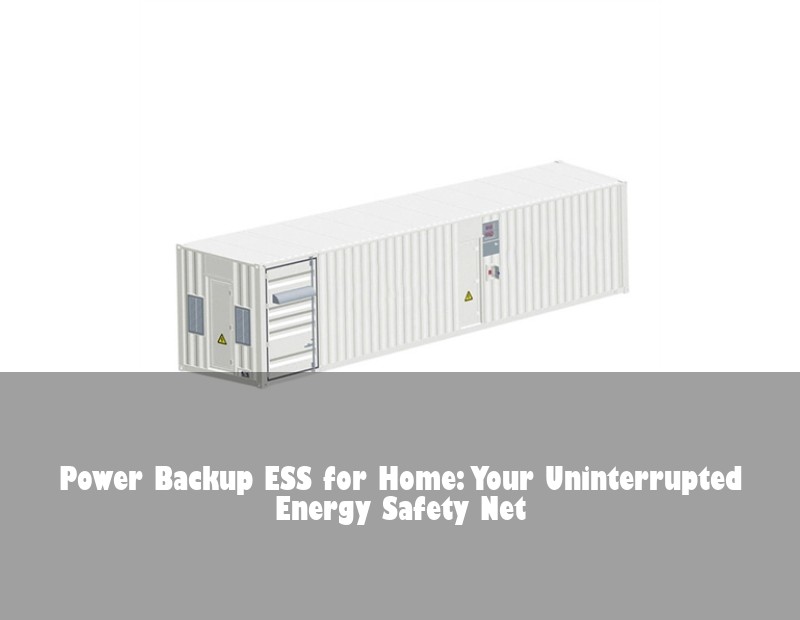
Imagine your freezer thawing during a storm-induced blackout while hospitals nearby rely on backup generators. Across Europe, homeowners face increasing power instability—from Germany's 2021 floods disrupting 200,000 households to Scandinavia's grid strain during polar vortexes. This growing vulnerability reveals a harsh truth: traditional grids can't match modern energy demands. Enter power backup ESS for home systems—intelligent energy storage solutions transforming passive consumers into resilient energy masters. Let's explore how these silent guardians empower your home against unpredictability.
Table of Contents
- The Uncomfortable Reality of Home Power Outages
- How Home ESS Rewrites the Power Security Equation
- Proof in Action: A Bavarian Family's Winter Resilience
- Choosing Your ESS: Key Technical Considerations
- Are You Prepared for Tomorrow's Energy Challenges?
 Image source: Unsplash - Professional residential ESS integrated with rooftop solar
The Uncomfortable Reality of Home Power Outages
Europe's energy landscape is shifting beneath our feet. Consider these realities:
- Outage duration increased by 17% across Western Europe since 2019 (ENTSO-E data)
- 42% of UK households experienced ≥3 outages during 2022's winter storms
- Food spoilage costs average €400 per incident for European families
Behind these numbers lie silent emergencies: medical devices failing, remote workers disconnected, security systems blinded. Yet most homeowners still rely on flickering candles or noisy petrol generators—19th-century solutions for 21st-century problems. Which brings us to an essential question: What if your home could anticipate disruptions rather than react to them?
How Home ESS Rewrites the Power Security Equation
Modern home energy storage systems (ESS) function like an intelligent energy heart. Here's their technical magic:
- Instant Failover: Seamless switch to battery power within 20ms of grid failure
- Solar Synergy: Stores excess solar energy instead of exporting at low feed-in tariffs
- AI Energy Routing: Prioritizes critical loads (fridges/medical devices) during prolonged outages
But how does this differ from traditional generators? Observe:
| Feature | Diesel Generator | Home ESS |
|---|---|---|
| Response Time | 10-60 seconds | <20 milliseconds |
| Noise Level | 70-100 dB | 0 dB (silent) |
| Maintenance | Monthly checks | Self-monitoring |
| Carbon Emissions | High | Zero (with solar) |
For example, an ESS automatically charges when energy prices drop overnight—a subtle efficiency that cuts bills while building resilience. As Michael, a solar installer from Lyon, notes: "Customers don't buy backup systems; they buy peace of mind that their child's asthma machine won't fail during storms."
Proof in Action: A Bavarian Family's Winter Resilience
The Haas family in Garmisch-Partenkirchen offers living proof. After their region experienced 15 grid failures during the 2023/24 winter (average duration: 4h 37m), they installed a 12kWh ESS paired with existing solar panels. The results?
- Zero downtime during 37 cumulative outage hours
- 75% reduction in generator fuel costs (€283 saved)
- Excess solar storage earned €61 in energy arbitrage

Their system automatically powered critical circuits during a severe ice storm while maintaining indoor temperatures at 19°C—all monitored remotely via smartphone. Climate researchers predict these events will increase by 300% in Southern Germany by 2030 (European Environment Agency), making such solutions essential rather than luxury.
Choosing Your ESS: Key Technical Considerations
Selecting your power backup ESS involves more than comparing kWh ratings. Focus on these critical aspects:
- Depth of Discharge (DoD): Opt for ≥90% DoD (e.g., lithium LFP chemistry) versus older batteries' 50-60% limit
- Scalability: Can you add modules later? Good systems expand in 2-3kWh increments
- Grid Interaction: Seek IEC 62619 certification for European safety standards compliance
- Software Intelligence: Dynamic algorithms that adapt to weather forecasts and tariff changes
Configuration matters profoundly. For a typical 3-bedroom home:
| Daily Consumption | Recommended ESS Size | Backup Duration* |
|---|---|---|
| 10-15 kWh | 8-10 kWh | 16-24 hours |
| 16-22 kWh | 12-15 kWh | 14-20 hours |
| *Assuming critical loads only (lighting, refrigeration, comms) | ||
Don't overlook the inverter's "black start" capability—its ability to reboot without grid support. This technical nuance becomes lifesaving during multi-day outages, as confirmed by recent IEC standards (International Electrotechnical Commission).
Are You Prepared for Tomorrow's Energy Challenges?
Consider this emerging reality: Italy's new building codes mandate ESS readiness for new constructions, while Sweden offers VAT rebates for home battery installations. Energy storage is evolving from emergency backup to intelligent energy management hubs that interact with smart grids (IRENA). So we leave you with this question: When your next power outage strikes—whether caused by extreme weather or grid upgrades—what will your family's first powerless hour look like, and how might that scenario change with an ESS silently standing guard in your basement?
 Inquiry
 Online Chat