


The Biggest Solar Power Generator: Revolutionizing Global Energy Landscapes
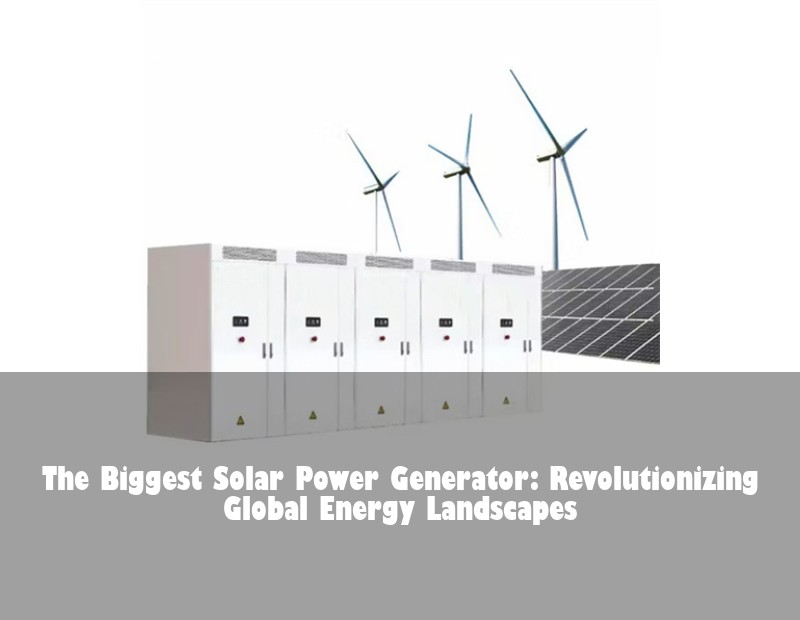
Imagine powering entire cities with sunlight alone. Across Europe, nations are embracing the world's biggest solar power generators – colossal installations transforming sunlight into grid-scale electricity. These engineering marvels aren't just solar farms; they're national infrastructure pillars accelerating decarbonization. Let's explore how these giants work, why Europe leads their deployment, and what they mean for our energy future.
Table of Contents
- The Evolution of Mega-Solar: From Rooftops to Power Stations
- How the Biggest Solar Generators Achieve Unprecedented Scale
- European Showcase: Spain's Núñez de Balboa Solar Power Plant
- Beyond Megawatts: Environmental and Economic Ripple Effects
- What's Next? Emerging Technologies in Utility-Scale Solar
- Your Role in the Solar Transformation
The Evolution of Mega-Solar: From Rooftops to Power Stations
Remember when "solar power" meant small rooftop panels? Today's solar generators occupy landscapes comparable to airports. Global utility-scale solar capacity grew 1,250% between 2010-2022, with Europe accounting for 30% of installations[IEA]. This shift from distributed to centralized solar reflects three critical developments:
- Cost Collapse: Utility-scale solar costs dropped 89% since 2009 – now cheaper than fossil fuels in most regions
- Policy Acceleration: EU's REPowerEU plan mandates 45% renewable energy by 2030, fast-tracking mega-projects
- Technological Leaps: Bifacial panels and AI tracking boost output by 25% versus legacy systems
How the Biggest Solar Generators Achieve Unprecedented Scale
The engineering behind gigawatt-scale solar involves intricate choreography between hardware and software. Consider the key components:
| Component | Innovation | Scale Impact |
|---|---|---|
| Solar Modules | 700W+ bifacial panels capturing ground-reflected light | 15-20% more yield per hectare |
| Tracking Systems | AI-powered sun-following algorithms | Optimizes angle 4,320x daily |
| Energy Storage | Co-located lithium-ion reservoirs | Extends operational hours by 300% |
Modern plants like Italy's Montalto di Castro (84MW) use predictive weather modeling to anticipate cloud cover, dynamically rerouting power flows. This isn't just bigger solar – it's smarter solar.
European Showcase: Spain's Núñez de Balboa Solar Power Plant
Let's examine the real-world impact through Europe's largest operational facility: Núñez de Balboa in Extremadura, Spain. This 500MW giant demonstrates how mega-solar transforms local economies and grids.
Project Vital Statistics
- Scale: 1,430 hectares (equivalent to 2,000 football fields)
- Output: Powers 250,000 homes annually
- CO2 Reduction: 215,000 tons/year – like removing 100,000 cars from roads
- Storage Integration: 20MW battery system smooths evening demand surges
Why does this matter? Beyond the numbers, Núñez de Balboa created 1,200 local jobs during construction and established a maintenance ecosystem that revitalized rural communities[Iberdrola]. It's proof that solar giants can deliver both electrons and economic vitality.
Beyond Megawatts: Environmental and Economic Ripple Effects
Large-scale solar farms create unexpected positive externalities. The UK's Cleve Hill Solar Park (350MW) integrates sheep grazing between panels – a practice now adopted by 65% of European solar farms. This agricultural symbiosis generates dual revenue streams while maintaining biodiversity.
Grid stability is another hidden benefit. When France's Cestas Solar Plant came online, its 300MW capacity provided crucial voltage support during peak demand, reducing grid upgrade costs by €40 million[Energy Storage News]. Utility operators call this the "stability dividend" – solar's ability to solve multiple infrastructure challenges simultaneously.
What's Next? Emerging Technologies in Utility-Scale Solar
Tomorrow's solar giants will look radically different. Two innovations poised for commercialization:
- Agrivoltaics 2.0: Vertical bifacial panels allowing full-scale farming beneath energy arrays
- Hydrogen Co-Generation: Using surplus solar for on-site green hydrogen production (pilot in Germany's Rhineland)
Portugal's Floating Solar Initiative offers another frontier – installing panels on reservoirs to conserve land while reducing water evaporation by 70%. As an industry insider recently told me: "We're moving from solar farms to solar ecosystems."
Your Role in the Solar Transformation
Seeing these technological leaps, what opportunities could your organization unlock with utility-scale solar? Whether you're a municipal planner considering land repurposing or an energy manager evaluating corporate PPAs, the megawatt-scale solar revolution offers unprecedented possibilities. Where will your community's first 100MW solar generator be built?
 Inquiry
 Online Chat