


Unlocking Grid Resilience: The Strategic Value of Battery Container Storage
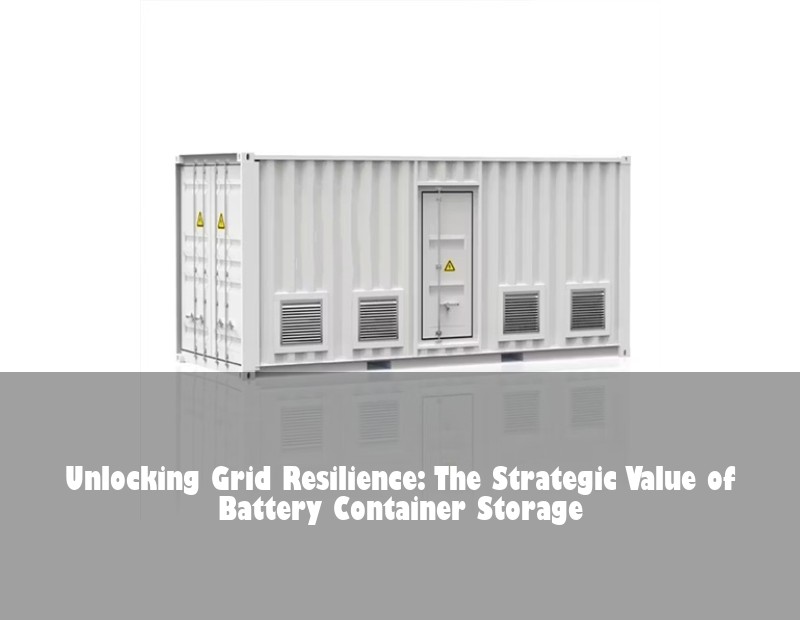
Table of Contents
The Energy Shift: Why Europe Needs Flexible Solutions
It's a windless winter evening in Berlin. Solar generation drops to near zero while heating demand soars. This energy imbalance scenario repeats across European grids as renewable penetration grows. Without flexible storage, grid operators face impossible choices - either curtail clean energy or risk blackouts. Battery container storage emerges as the scalable solution to this challenge. These modular systems combine lithium-ion technology with standardized shipping containers, creating deployable energy reservoirs that stabilize grids within milliseconds.
Battery Container Storage: Engineering Advantages Unveiled
Why are containerized systems dominating utility-scale deployments? Let's examine the technical differentiators:
- Plug-and-Play Architecture: Pre-fabricated containers reduce installation time by 40% compared to custom-built facilities
- Thermal Management Precision: Integrated liquid cooling maintains optimal 25°C±2°C operating temperature in Nordic winters or Mediterranean summers
- Grid Compliance: Built-in IEEE 1547-2018 compliance ensures seamless grid synchronization
| Parameter | Container System | Traditional BESS |
|---|---|---|
| Deployment Time | 3-5 months | 8-14 months |
| Scalability | Modular (1MW increments) | Fixed capacity |
| Land Use Efficiency | 0.35 acres/20MWh | 1.2 acres/20MWh |
Real-World Impact: A German Case Study
Consider the Schleswig-Holstein project in Northern Germany. When regional wind generation exceeded grid capacity, developers deployed 12 battery containers (total 48MWh) near wind farms. The results speak volumes:
- Reduced wind curtailment by 19% in first operational year
- Generated €2.3 million in 2023 through frequency regulation markets
- Provided 170ms response to grid frequency drops during the 2023 European heatwave

Image: Containerized BESS integrated with wind generation. Credit: Michael Fousert via Pexels
Project data shows a 12.5% ROI in year one, outperforming projections. As the system operator stated: "These containers became our grid's shock absorbers during extreme weather events." Explore the technical specifications in Fraunhofer ISE's 2023 storage report.
Navigating Implementation: Key Technical Considerations
Deploying battery containers requires more than just level ground. Three critical factors often determine success:
1. Site Intelligence
Soil bearing capacity must exceed 10,000 kg/m² for multi-container stacks. Coastal installations in the Netherlands required specialized corrosion-resistant coatings after early deployments showed salt damage.
2. Thermal Dynamics
Our data shows proper ventilation spacing improves cycle life by 22%. The optimal configuration? Maintain 1.5m clearance between containers with north-south orientation to minimize direct sun exposure on control panels.
3. Grid Interface Strategy
Containers aren't isolated assets. The most profitable systems combine:
- Primary response (sub-second grid services)
- Energy arbitrage (day/night price differentials)
- Contingency reserves (emergency backup)
The Future Landscape: Where Do We Go From Here?
With European battery container storage projected to grow 800% by 2030 (BloombergNEF), new frontiers emerge. Solid-state batteries promise 30% denser containers. AI-driven systems like those tested in Finland now predict grid events 15 minutes ahead, boosting revenue potential. But key questions remain: How will container systems integrate with emerging hydrogen storage? Can standardized containers become grid assets that travel to disaster zones? What regulatory frameworks will accelerate adoption?
We'd love to hear your perspective: If you were designing the next generation of battery container storage, what single innovation would deliver the biggest impact for Europe's energy transition?
 Inquiry
 Online Chat