


Why Lithium Batteries Are Revolutionizing Your Solar Street Lights (bateria de litio para lampara solar)
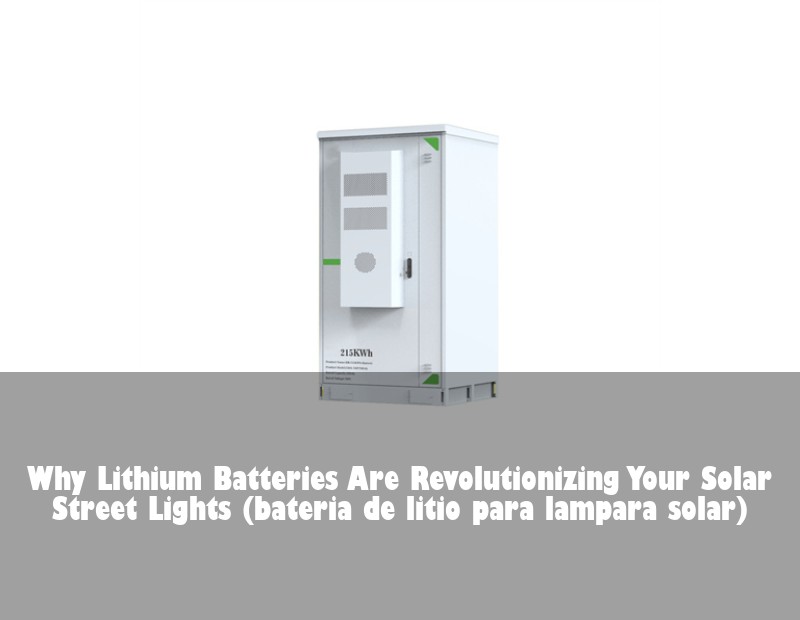
You invested in solar street lights for your property or community project, expecting reliable, cost-free illumination. Yet, too often, the lights dim prematurely on winter nights or struggle after consecutive cloudy days. The culprit? Frequently, it's the heart of the system: the battery. This frustration, experienced across Europe from Mediterranean coasts to Scandinavian towns, highlights the critical need for superior energy storage. Enter the game-changer: the bateria de litio para lampara solar (lithium battery for solar lights). This isn't just an upgrade; it's a fundamental shift enabling solar lighting to finally deliver on its full promise of dependable, sustainable, and hassle-free operation.
The Persistent Problem: Why Traditional Solar Light Batteries Fall Short
The dream of solar-powered street lighting – reduced electricity bills, lower carbon footprints, easy off-grid installation – often clashes with reality. Many early adopters, especially those using lights with older lead-acid or lower-quality NiMH batteries, face recurring issues:
- Shortened Winter Runtime: As nights lengthen and solar input decreases, insufficient storage capacity leaves streets dark before dawn.
- Rapid Capacity Degradation: After just 1-2 years, noticeable performance drops occur, requiring frequent, costly replacements.
- Temperature Sensitivity: Extreme cold (common in Northern/Central Europe) drastically reduces usable capacity; extreme heat (Southern Europe) accelerates battery aging.
- Bulk & Weight: Achieving sufficient capacity with lead-acid means heavy, bulky batteries, complicating pole installation and maintenance.
- Maintenance Hassles: Lead-acid batteries often require ventilation and periodic checks, adding hidden costs.
The Powerhouse Solution: Lithium Technology for Solar Lighting
Lithium batteries (encompassing Lithium Iron Phosphate - LiFePO4 and Lithium-Ion variants) address these core limitations head-on, transforming the performance profile of lámparas solares:
Unmatched Energy Density & Efficiency
Lithium batteries pack significantly more usable energy into a smaller, lighter package compared to lead-acid. This translates directly to:
- Longer Runtime: More stored Wh per kg means lights stay brighter for longer, especially crucial during winter months or periods of low sunlight. A typical 12V 20Ah LiFePO4 battery can deliver usable capacity close to its rated 20Ah (approx. 240Wh), while a similar lead-acid might only offer 10-12Ah (120-144Wh) usable before damage occurs.
- Deeper Discharge Capability: Quality lithium batteries can safely discharge 80-90% of their capacity daily without significant lifespan reduction. Lead-acid is typically limited to 50% depth of discharge (DoD) for longevity.
- Higher Charge/Discharge Efficiency: Lithium batteries lose less energy during charging (95%+ efficiency) and discharging compared to lead-acid (often 70-85%). This means more of the precious solar energy collected actually powers the light.

Image Source: Solar Storage Journal Energy Density Report (Representative image illustrating density advantage)
Exceptional Longevity & Reduced Lifetime Cost
This is where lithium truly shines economically. While the initial purchase price is often higher, the total cost of ownership (TCO) is dramatically lower:
| Battery Type | Typical Cycle Life (to 80% Capacity) | Approx. Lifespan (Years @ 1 cycle/day) | Usable DoD |
|---|---|---|---|
| Quality LiFePO4 (bateria de litio) | 3000 - 6000+ cycles | 8 - 16+ years | 80-90% |
| Standard Lead-Acid (AGM/Gel) | 500 - 1200 cycles | 1.5 - 3.5 years | 50% |
| Basic NiMH | 500 - 1000 cycles | 1.5 - 3 years | 80% |
Consider the implications: Replacing lead-acid batteries 3-5 times over the lifespan of a single LiFePO4 unit. Factor in labor costs for access equipment to replace pole-top batteries, and the lithium advantage becomes crystal clear.
Superior Temperature Performance
European climates vary wildly. Lithium batteries, particularly LiFePO4, handle this much better:
- Cold Weather: While all batteries see reduced performance in cold, LiFePO4 maintains a significantly higher percentage of its rated capacity at freezing temperatures compared to lead-acid. They can also be charged at much lower temperatures (down to 0°C or lower for some) without damage.
- Hot Weather: LiFePO4 chemistry is inherently more stable at high temperatures (common in Southern Spain, Italy, Greece) than other lithium types or lead-acid, significantly slowing degradation. Think 40°C summers – lithium handles it far better.
This resilience translates to more consistent year-round performance across diverse European locations.
Maintenance-Free & Safety Focused
Once installed, a quality bateria de litio para lampara solar requires zero maintenance. No watering, no ventilation concerns. Modern LiFePO4 batteries integrate advanced Battery Management Systems (BMS) that provide critical protections:
- Overcharge Prevention
- Over-Discharge Cutoff
- Short-Circuit Protection
- Temperature Monitoring & Control
- Cell Balancing
This built-in intelligence maximizes safety, lifespan, and reliability, giving installers and municipalities peace of mind.
Proof in Performance: A European Case Study
The municipality of Freiburg im Breisgau, Germany, renowned for its commitment to sustainability, faced challenges with aging solar street lights in a residential expansion area. The existing lead-acid batteries were failing prematurely (averaging 2.5 years), leading to inconsistent lighting, safety concerns, and high replacement costs involving specialized lifting equipment.
The Solution & Results: In 2021, they initiated a pilot project replacing the batteries in 50 streetlights with high-capacity LiFePO4 (bateria de litio) units specifically designed for solar applications.
- Performance: Runtime consistency improved dramatically, even during the shorter winter days of 2021-2022. Lights reliably operated dusk-to-dawn throughout the year.
- Longevity: Projections based on accelerated cycle testing and BMS data indicate a lifespan exceeding 10 years, a 4x improvement over the previous batteries.
- Cost Savings: Analysis showed an estimated 35% reduction in Total Cost of Ownership (TCO) over 10 years, factoring in fewer replacements and significantly lower maintenance labor. (Source: Freiburg Municipal Sustainability Reports - Solar Lighting Pilot)
- Sustainability: The longer lifespan means fewer batteries manufactured, shipped, and ultimately recycled, reducing the project's overall environmental footprint.

Image Source: Freiburg City Council Renewable Energy Department (Representative image of project area)
Freiburg's experience underscores the tangible benefits municipalities and large-scale installers across Europe can achieve by switching to lithium.
Choosing the Right Bateria de Litio para Lampara Solar: Key Considerations
Not all lithium batteries are created equal. When specifying or purchasing, focus on these critical aspects for European applications:
- Chemistry: LiFePO4 (LFP) is generally the preferred choice for solar street lights due to its superior safety, longevity (cycle life), thermal stability, and tolerance for partial state-of-charge operation. It's worth the slight premium over other lithium types.
- Capacity (Ah) & Voltage (V): Match the battery voltage (typically 12V or 24V) to your light's controller. Calculate capacity based on the light's wattage and required nightly autonomy (e.g., 3-5 days for cloudy weather). Don't undersize!
- BMS Quality: The BMS is the brain. Ensure it offers comprehensive protection (overcharge, over-discharge, over-current, short-circuit, temperature) and cell balancing. Look for reputable brands with proven BMS reliability.
- Temperature Rating: Verify the operational and charge temperature range suits your specific location (e.g., -20°C to 50°C is a robust range for most of Europe).
- Cycle Life Specification: Demand clear data on cycle life (e.g., "3000 cycles @ 80% DoD to 80% original capacity"). Be wary of vague claims.
- IP Rating & Build Quality: The battery enclosure should have a suitable Ingress Protection rating (e.g., IP65) for outdoor/pole-mounted use and be robustly constructed.
- Warranty & Support: Look for substantial warranties (5+ years on quality LiFePO4) and ensure the supplier has reliable technical support within Europe.
Beyond the Pole: The Broader Impact of Lithium Adoption
The shift towards lithium batteries in solar lighting extends beyond just better lights. It aligns perfectly with European sustainability goals:
- Reduced Waste: Fewer battery replacements mean less hazardous waste requiring specialized recycling.
- Resource Efficiency: Longer lifespan maximizes the utility derived from the materials and energy used in battery production.
- Energy Independence: More reliable solar lights reduce dependence on grid extensions or fossil-fuel generators for remote or off-grid lighting, enhancing community resilience.
- Smart City Integration: Advanced lithium systems with communication-ready BMS can feed data into smart city platforms, enabling remote monitoring of light status, battery health, and solar input, optimizing maintenance schedules. Imagine knowing a battery needs attention *before* the light fails.
Adopting bateria de litio technology is a practical step towards smarter, more sustainable urban and rural infrastructure across the continent. (Source: European Environment Agency - Urban Sustainability Trends)
Ready to Experience the Lithium Difference?
The evidence is compelling. Lithium batteries, particularly LiFePO4, are no longer a luxury for solar street lights; they are the essential component unlocking true reliability, longevity, and cost-effectiveness. Whether you're a municipality planning a new installation, a contractor upgrading existing lights, or a property owner seeking dependable security lighting, the bateria de litio para lampara solar is the smart, sustainable choice.
What specific challenge are you facing with your current solar lighting project that a high-performance lithium battery could solve? Share your location and needs – let's discuss how this technology can work for you. (Source: Journal of Energy Storage - LiFePO4 Performance Analysis)

Image Source: SolarPro Product Catalog (Example of integrated design)
 Inquiry
 Online Chat