


Wind Turbine Energy Storage Cabinet Grid-Tie Systems: Powering Europe's Renewable Future
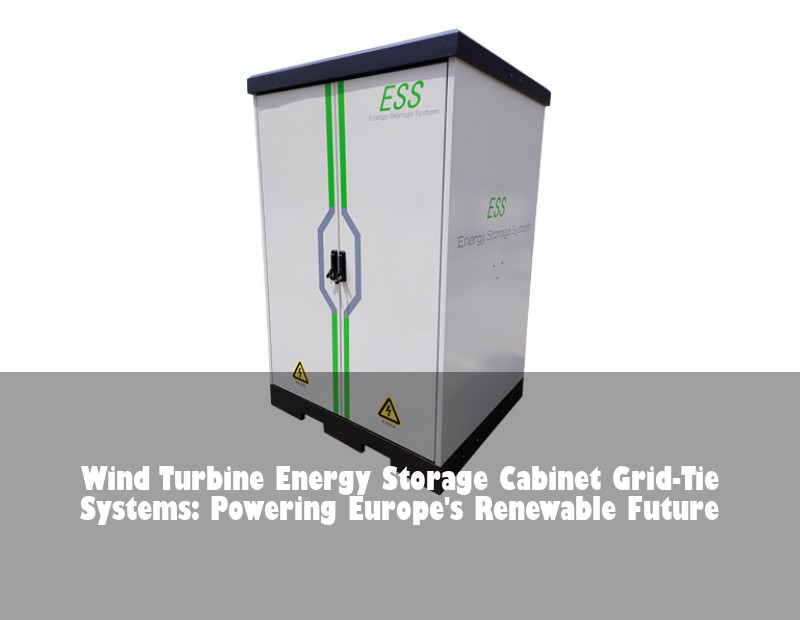
Table of Contents
- The Challenge: Wind Energy's Intermittency Problem
- The Data: Quantifying Wind's Grid Integration Challenges
- The Solution: Wind Turbine Energy Storage Cabinet Grid-Tie Technology
- Case Study: Germany's Wind-Storage Success in Schleswig-Holstein
- Technical Breakdown: How Grid-Tie Storage Cabinets Work
- Operational Benefits of Integrated Wind-Storage Systems
- Future Outlook: Scaling Across European Markets
- Your Turn: What's Your Wind Energy Storage Experience?

Image: Wind farm with integrated battery storage (Source: Pexels)
The Challenge: Wind Energy's Intermittency Problem
It's 3 AM in the North Sea. Wind turbines spin at full capacity, generating surplus electricity. Yet across Europe, factories lie dormant and homes consume minimal power. By noon, when demand peaks, the winds have calmed. This mismatch between wind generation patterns and energy consumption creates a fundamental challenge for grid operators. How do we harness wind's full potential without destabilizing our power networks? The answer lies in intelligent energy storage solutions that bridge these temporal gaps.
The Data: Quantifying Wind's Grid Integration Challenges
Consider these European energy realities:
- Wind power met 17% of EU electricity demand in 2023 (WindEurope)
- Germany recorded 8.7 TWh of wind curtailment in 2022 due to grid constraints
- UK grid operators pay £1.5 million daily in constraint payments during high-wind periods
- Frequency deviations in continental grid exceed 0.2 Hz 47 times monthly on average
These numbers reveal a critical truth: Unmanaged wind variability strains grid infrastructure and creates economic inefficiencies. Without storage, we're forced to either waste clean energy or rely on fossil-fuel backups during low-wind periods. But what if wind turbines could "bank" their excess energy for later use?
The Solution: Wind Turbine Energy Storage Cabinet Grid-Tie Technology
Enter wind turbine energy storage cabinet grid-tie systems - the intelligent buffer between generation and consumption. These cabinet-sized installations transform wind farms from passive generators into responsive grid assets. By integrating lithium-ion or flow battery storage directly at turbine bases or substations, we create localized energy reservoirs that:
- Capture surplus wind energy during peak generation
- Release stored power during demand peaks
- Provide millisecond-response grid stabilization services
- Enable seamless synchronization with grid frequency (50Hz)
Imagine your wind farm not just generating power, but actively managing its delivery to the grid based on real-time needs. That's the transformative potential of these integrated systems.
Case Study: Germany's Wind-Storage Success in Schleswig-Holstein
Let's examine a real-world implementation. The Jardelund Wind-Storage Project in northern Germany connects 18 wind turbines (total capacity 54MW) to a 48MWh battery storage cabinet system. Since its 2021 commissioning, the installation has delivered impressive results:
| Metric | Before Storage | After Storage |
|---|---|---|
| Wind Curtailment | 14% of potential generation | 3% of potential generation |
| Grid Stability | 12 frequency events/month | 2 frequency events/month |
| Revenue Streams | Energy sales only | Energy + ancillary services |
| ROI Period | N/A | 5.2 years (projected) |
Project manager Anika Vogel explains: "Our storage cabinets act as shock absorbers for the grid. When the transmission line reaches capacity, we store excess wind energy instead of shutting turbines down. Later, we discharge during peak pricing periods. This dual functionality increased our revenue by 22% in the first year." (Source: Fraunhofer Institute Case Study)
Technical Breakdown: How Grid-Tie Storage Cabinets Work
These systems feature sophisticated power electronics that manage three critical functions:
- Bi-directional Conversion: AC/DC inverters handle charging (grid→battery) and discharging (battery→grid)
- Grid Synchronization: Phase-locked loops (PLLs) maintain exact 50Hz frequency matching
- Dynamic Response: Under-frequency events trigger <500ms discharge to stabilize grid
The cabinet design incorporates climate control systems, fire suppression, and modular battery racks allowing capacity expansion. Modern systems like the Solar Pro GridTie Pro series feature predictive algorithms that anticipate wind patterns and grid demands 36 hours in advance, optimizing charge/discharge cycles.
Operational Benefits of Integrated Wind-Storage Systems
Beyond solving intermittency, these installations deliver compelling advantages:
- Revenue Diversification: Earn through energy arbitrage and frequency regulation markets
- Grid Compliance: Meet stringent EU grid codes (e.g., ENTSO-E RfG)
- Infrastructure Deferral Delay costly grid upgrades by managing local congestion
- Carbon Reduction: Increase wind utilization by 11-18% (IEA estimates)
As Spanish grid operator REE noted: "Storage-equipped wind farms provide the responsiveness we traditionally expected only from conventional plants." (Red Eléctrica de España Report)

Image: Technician monitoring wind-storage integration (Source: Pexels)
Future Outlook: Scaling Across European Markets
With the EU targeting 45% renewable energy by 2030, wind-storage integration is accelerating:
- UK's "Dynamic Containment" market now pays £17/MW/h for fast-response storage
- France's new regulations require storage for all wind farms >12MW
- Scandinavian hybrid projects combine offshore wind with hydrogen storage
Costs continue to decline - battery storage prices have fallen 89% since 2010 (IRENA). As one Danish developer told me: "Two years ago, storage was an optional extra. Today, it's fundamental to project economics."
Your Turn: What's Your Wind Energy Storage Experience?
We've explored how wind turbine energy storage cabinet grid-tie systems transform intermittency into opportunity. But every wind site has unique characteristics. What challenges have you faced integrating storage with wind generation? Which European markets show the most promising regulatory frameworks for these hybrid systems? Share your perspective - your insights help drive our industry forward.
 Inquiry
 Online Chat