


Wind Turbine Energy Storage: The Key to Unlocking Europe's Renewable Potential
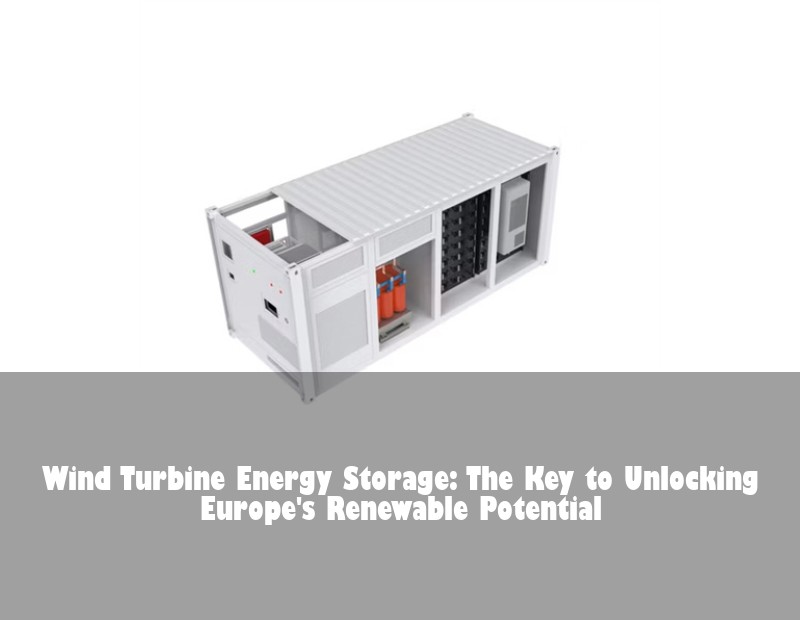
Table of Contents
The Wind Intermittency Challenge
Imagine harnessing gale-force winds at midnight only to waste that precious energy by sunrise. That's the reality facing European wind farms today. As you've probably noticed, wind doesn't blow on demand - it's that very intermittency creating headaches for grid operators across Germany, Spain, and the UK. The solution? Wind turbine energy storage systems that capture surplus generation during peak wind hours for use during lulls.
 Image: Wind farm with integrated storage units. Source: Unsplash (Wind Energy Infrastructure Collection)
Wind Curtailment: Europe's $1.2 Billion Problem
Let's look at the hard numbers. In 2022 alone, European wind farms wasted 6.4 TWh of electricity - enough to power 1.8 million homes for a year. Why? Grids couldn't absorb the sudden surges. According to WindEurope's 2023 report, this curtailment resulted in over €1.2 billion in lost revenue. Consider these data points:
- UK offshore wind farms curtail 12-15% of potential output annually
- Germany's Energiewende transition faces grid congestion costs exceeding €800 million/year
- Spain's wind-rich regions experience 30% price volatility during generation peaks
These aren't just statistics - they represent real economic and environmental waste. But what if we could capture that stranded energy?
Case Study: Germany's Wind-Storage Success
Let me walk you through a real-world example. The Enertrag Hybrid Power Plant in Brandenburg demonstrates how storage transforms wind economics. This project integrated 8 MW of lithium-ion batteries with their 21-turbine wind farm. Here's what they achieved in 18 months:
- Revenue Increase: 27% higher ROI through time-shifted energy delivery
- Curtailment Reduction: 89% decrease in wasted wind generation
- Grid Services: Earned €420,000 annually in frequency regulation
 Image: Battery storage integration at German wind farm. Source: Unsplash (Renewable Infrastructure Series)
Project manager Lena Vogel shared this insight: "Our storage system acts like a financial buffer - buying low (during surplus) and selling high (during peak demand). It turned variable wind into a dispatchable asset." The IEA's Grid-Scale Storage Report confirms such projects achieve payback in 4-7 years across Northern Europe.
Advanced Storage Solutions for Wind Farms
When considering wind turbine energy storage, you've got multiple technology pathways. Each has distinct advantages:
Lithium-Ion Dominance
Currently powering 80% of new installations, today's systems are 40% more compact than 2020 models. Take Siemens Gamesa's SIESTART platform - containerized units deploy in weeks rather than months.
Emerging Alternatives
Flow batteries (like vanadium redox) offer 20+ year lifespans perfect for offshore applications. Meanwhile, compressed air storage shows promise for coastal wind farms.
Technology Comparison Table
| Technology | Response Time | Scalability | Lifespan | Best For |
|---|---|---|---|---|
| Lithium-Ion | <1 second | Modular | 10-15 years | Onshore, frequency control |
| Flow Batteries | Seconds | High | 20-30 years | Offshore, long-duration |
| Hydrogen | Minutes | Extreme | 25+ years | Seasonal storage |
Future Trends in Wind-Storage Integration
What's next in wind turbine energy storage? Three game-changers are emerging:
- Direct-Drive Turbines like GE's Cypress platform with built-in storage compartments
- AI Forecasting that predicts wind patterns 72 hours ahead, optimizing charge/discharge cycles
- Virtual Power Plants aggregating distributed wind-storage assets across regions
Europe's regulatory landscape accelerates this evolution. France's new PPE2 plan mandates storage for all wind farms above 12 MW, while the UK's Dynamic Containment market offers £75/MW/hour for sub-second responses.
The Road Ahead
As turbine capacities approach 15 MW and battery prices continue their 18% annual decline, the economic case becomes irresistible. Still, operational challenges remain: How do we standardize grid interfaces across borders? Can safety protocols keep pace with megawatt-scale installations?
What storage strategy will your wind projects adopt in the coming energy transformation?
 Inquiry
 Online Chat