


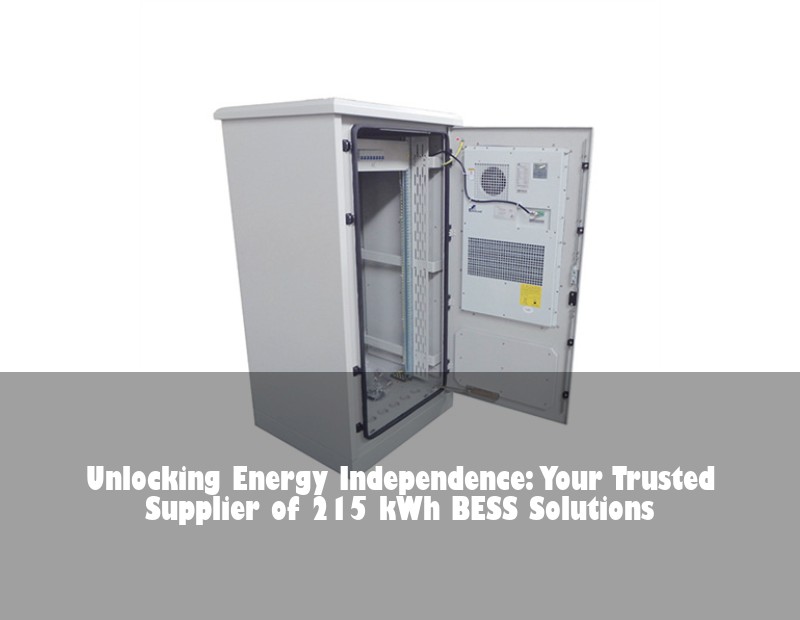
Unlocking Energy Independence: Your Trusted Supplier of 215 kWh BESS Solutions
Across European homes and businesses, a quiet energy revolution is underway. As electricity prices swing unpredictably and grid stability becomes a growing concern, more energy-conscious consumers are asking: "How can I take control of my power supply?" This is where Battery Energy Storage Systems (BESS) shine – and as a leading supplier of 215 kWh BESS solutions, we're seeing this size emerge as the Goldilocks zone for medium-scale applications. Let's explore why this specific capacity is transforming Europe's energy landscape.
Table of Contents
- Europe's Energy Storage Boom: Beyond the Headlines
- Why 215 kWh? The Sweet Spot for Commercial & Industrial Applications
- Real-World Impact: Hamburg Logistics Center Case Study
- Choosing Your 215 kWh BESS Partner: 5 Non-Negotiables
- Beyond Storage: The Evolving Role of BESS in Grid Services
- Is Your Energy Strategy Ready for the Next Phase?
Europe's Energy Storage Boom: Beyond the Headlines
Remember the 2022 energy crisis? It wasn't just headlines – it was a wake-up call. European commercial electricity prices spiked by up to 79% year-over-year in some markets (source: Enerdata), forcing businesses to rethink energy strategies. But here's the hopeful trend: BESS installations in Europe grew by 94% YoY in 2023 (European Association for Storage of Energy). Why this surge?
- Grid operators offering new revenue streams for frequency regulation
- Payback periods shrinking below 5 years in high-tariff regions
- Solar pairing making renewable investments 40% more efficient

Image: Solar-plus-storage installations like this German site increasingly utilize 200-250kWh units (Source: SolarPower Europe)
Why 215 kWh? The Sweet Spot for Commercial & Industrial Applications
Through hundreds of deployments, we've found 215 kWh hits the operational sweet spot – not by accident, but by design. It's like the just-right porridge of energy storage: enough capacity for meaningful impact without overengineering. Consider these technical advantages:
| BESS Size | Typical Applications | Peak Demand Coverage |
|---|---|---|
| 50-100 kWh | Residential/SMB | 30-50% |
| 215 kWh | Medium factories, hotels, schools | 60-75% |
| 500+ kWh | Utility-scale | 90%+ (but higher complexity) |
What makes our 215 kWh units particularly effective? Three hidden design advantages:
- Grid-friendly scalability – Units can be stacked without triggering complex grid interconnection studies in most EU countries
- Thermal efficiency – Proprietary liquid cooling maintains optimal 25°C±2°C operation in Scandinavian winters to Mediterranean summers
- Cycling economics – LFP chemistry delivers 6,000+ cycles at 90% DoD, extending ROI beyond warranty periods
Real-World Impact: Hamburg Logistics Center Case Study
Let's get concrete. In 2023, we deployed four 215 kWh BESS units at a refrigerated logistics hub near Hamburg – a perfect storm of high energy needs and volatile pricing. Here's what the numbers revealed after 12 months:
- ⚡ Peak shaving: Reduced grid demand charges by €18,700 annually
- 🌞 Solar optimization: Increased onsite PV self-consumption from 48% to 82%
- 🔄 Grid services: Earned €6,200 through primary frequency response (PFR) programs
- 💸 ROI timeline: Achieved payback in 4.2 years – 11 months faster than projected
"The modularity was key," noted facility manager Anika Vogel. "When we expanded our cold storage, we simply added another 215kWh unit rather than redesigning the whole system."
Choosing Your 215 kWh BESS Partner: 5 Non-Negotiables
Not all BESS suppliers understand European nuances. When evaluating partners, demand these essentials:
- Localized grid compliance – Can they provide country-specific DNSP (Distribution Network Service Provider) approval packages?
- Performance transparency – Do they offer real-time monitoring with API integration to existing EMS?
- Thermal management pedigree – Ask for summer/winter performance data from similar climates
- Cybersecurity protocols – Require IEC 62443 certification documentation
- Battery provenance – Demand full cell traceability to avoid future CBAM complications

Image: Real-time monitoring is critical for BESS performance optimization (Source: Industry Europe)
Beyond Storage: The Evolving Role of BESS in Grid Services
Forward-thinking operators now view BESS as revenue generators, not just cost centers. Consider these emerging opportunities:
- Italy's UVAM program pays €45,000/MW/year for virtual aggregation
- UK's Dynamic Containment offers £17/MW/h for rapid frequency response
- France's Réseau de Transport d'Électricité auctions for symmetrical reserves
Our 215 kWh units include built-in grid service compatibility – no expensive retrofits needed when regulations evolve. As ENTSO-E finalizes its 2025 grid code amendments, this flexibility becomes critical.
Is Your Energy Strategy Ready for the Next Phase?
We've explored how 215 kWh BESS systems solve real problems – but here's my challenge to you: What energy pain point keeps you awake at night? Is it unpredictable operating costs? Renewable curtailment? Or perhaps preparing for future carbon pricing mechanisms? Whatever your priority, one truth remains: energy resilience isn't coming – it's already here. The question is, will you be powering ahead or playing catch-up?
 Inquiry
 Online Chat