


Solar Power for Irrigation: Transforming Agriculture in Europe
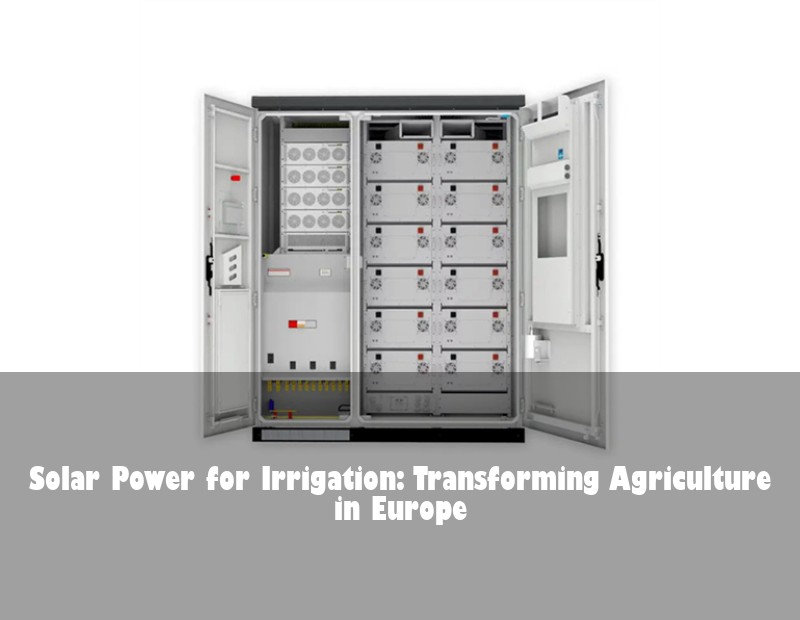
Table of Contents
The Water-Energy Nexus Crisis
European farmers facing a double bind. Irrigation accounts for up to 70% of freshwater use globally (FAO), but powering traditional pumps devours electricity at €2,500-€5,000 annually per hectare. With diesel prices soaring 40% since 2020 (Eurostat), you're not just growing crops—you're growing costs. Remember the 2022 European drought? When water scarcity met energy volatility, profits evaporated faster than soil moisture. That's where solar power for irrigation steps in—not just as an alternative, but as a resilience strategy.
 Image source: Unsplash/Farm with solar panels
Solar-Powered Irrigation: Sunlight to Water Flow
How does it translate sunlight to water? Solar panels convert photons into DC electricity, feeding variable frequency drives (VFDs) that adapt pump speeds to real-time conditions. Modern systems like SolarPro's AquaFlow® integrate:
- Smart inverters with MPP tracking for cloudy days
- IoT soil moisture sensors for precision watering
- Battery-less designs that reduce costs by 25%
As Dr. Elena Rossi from Milan's AgriTech Institute notes: "The beauty lies in synchronization—pumping peaks when sun intensity does, eliminating energy waste." No more midnight diesel runs or grid dependency.
Case Study: Andalusia's 400-Hectare Transformation
In Spain's drought-stricken olive region, Hacienda Verde adopted solar irrigation in 2021. Results after two seasons:
| Metric | Pre-Solar | Post-Solar |
|---|---|---|
| Energy Costs | €34,000/year | €0 |
| Water Savings | — | 19% (smart sensors) |
| Yield Increase | 12 tons/ha | 15 tons/ha |
| CO2 Reduction | — | 78 tons/year |
Their 340kW solar array powers 32 submersible pumps, with excess energy sold to Spain's grid under Royal Decree 244/2019. Farm manager Carlos Mendez revealed: "We recovered our investment in 4 years—now every sunrise is money in the bank."
The Economic Advantage: Crunching the Numbers
Why are 38% of EU farms exploring solar irrigation? Let's break it down:
- ROI Acceleration: EU subsidies cover 30-50% of installation costs (CAP 2023-27)
- Maintenance: Solar pumps require 70% less upkeep than diesel equivalents
- Scalability: Start with 5kW for small plots, expand modularly
 Image source: Unsplash/Solar pump schematic
Implementation Guide: Avoiding Common Pitfalls
Based on 120+ European deployments, here’s how to ensure success:
- Site Audit: Assess water table depth, daily flow needs, and solar exposure using tools like PVGIS
- Component Matching: Pair high-lift pumps (for deep wells) with 72-cell monocrystalline panels
- Smart Controllers: Integrate rainfall prediction algorithms to prevent overwatering
Pro tip: In cloudy regions like Ireland, hybrid systems with small batteries maintain operation during 3-day low-light periods.
The Horizon: AI and Water-Energy Synergy
Emerging innovations are reshaping solar irrigation:
- Germany's Fraunhofer Institute pilots AI that predicts crop water needs 72 hours ahead
- Floating solar panels on irrigation reservoirs (gaining 15% efficiency from water cooling)
- Blockchain-enabled water credits for surplus solar energy
As you contemplate your next irrigation upgrade, consider this: With Europe targeting 60GW of agri-PV by 2030, could your farm become both a food and energy producer? What's the first step you'll take to harness the sun?
 Inquiry
 Online Chat