


Solar DC Energy Storage Cabinet: The Future-Proof Backbone of Renewable Systems
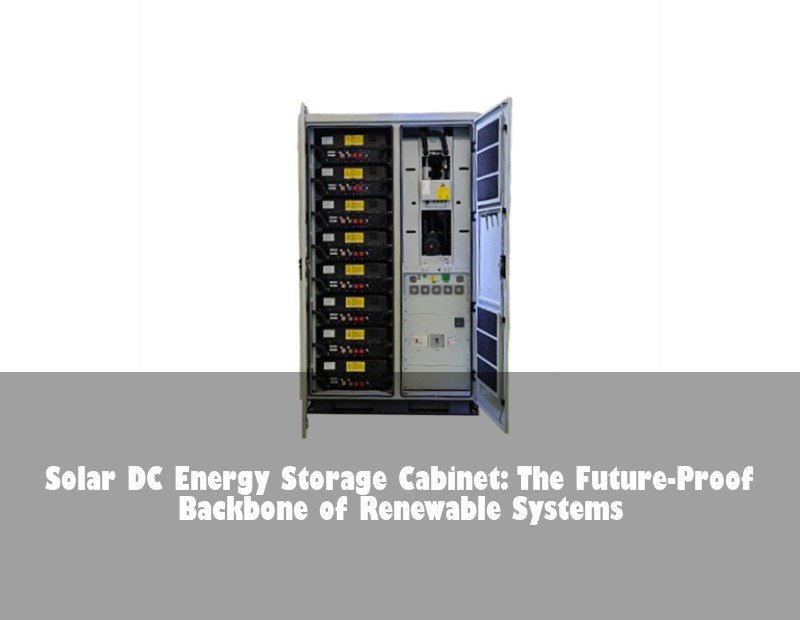
Table of Contents
- The Solar Dilemma: Sunlight Isn't Always Electricity
- What Makes Solar DC Energy Storage Cabinets Revolutionary?
- The Efficiency Edge: Why DC Coupling Matters
- Real-World Results: A German Hospital Case Study
- Choosing Your Solar DC Energy Storage Cabinet: Key Considerations
- Installation & Maintenance: Pro Tips for Longevity
- Beyond Storage: Intelligent Energy Management
The Solar Dilemma: Sunlight Isn't Always Electricity
Ever noticed how solar panels produce most energy at midday—when your home or business often needs it least? Across Europe, this mismatch creates a frustrating paradox: peak generation coincides with low consumption. In Spain, for instance, solar curtailment rates reached 3.4% in 2022 according to IRENA, wasting enough energy to power 40,000 homes annually. This isn't just inefficient; it's costly. Enter the solar DC energy storage cabinet—a game-changing solution that captures surplus solar power exactly when panels produce it, in its native DC form. No more watching valuable electrons vanish into thin air!

Image: Solar + storage integration in commercial applications (Credit: Unsplash/Andreas Gücklhorn)
What Makes Solar DC Energy Storage Cabinets Revolutionary?
Unlike traditional AC-coupled batteries, a solar DC energy storage cabinet connects directly between your PV array and inverter. Think of it as a native "translator" for solar energy—no complex conversions needed. This plug-and-play unit typically integrates:
- High-density lithium-ion or LFP battery modules
- Built-in DC-DC converters and battery management systems (BMS)
- Thermal regulation with liquid cooling systems
- Grid-forming capabilities for blackout resilience
By handling energy in its original DC form, these cabinets eliminate conversion losses—making them 8-12% more efficient than AC alternatives. For a medium-sized European business, this could mean €4,200+ annual savings based on average 2023 electricity prices.
The Efficiency Edge: Why DC Coupling Matters
Let's break down the magic: Traditional systems convert DC solar → AC for use → DC again for battery storage → back to AC when needed. Each conversion loses 3-5% energy. DC-coupled cabinets? One conversion only. See the difference in real numbers:
| System Type | Conversion Steps | Typical Efficiency Loss | Annual Energy Savings* |
|---|---|---|---|
| AC-Coupled Storage | 3 (DC→AC→DC→AC) | 12-18% | 0 kWh |
| DC-Coupled Cabinet | 1 (DC→DC) | 3-5% | 1,150 kWh |
*Based on 10kW system in Munich, Germany. Source: Fraunhofer Institute
Real-World Results: A German Hospital Case Study
When Berlin's Charité Hospital installed 4x SolarPro DC cabinets in 2021, the results stunned even engineers:
- Self-consumption boost: From 35% to 89% of solar energy used on-site
- Grid dependence reduction: 78% decrease in peak-demand grid draws
- ROI timeline: 4.2 years (vs. projected 6.5 years)
"During the 2022 energy crisis, our cabinets provided 92 hours of backup power," notes Facility Manager Klaus Bauer. "We didn't just save money—we maintained critical care without interruption."

Image: DC cabinet monitoring interface in commercial use (Credit: Unsplash/American Public Power Association)
Choosing Your Solar DC Energy Storage Cabinet: Key Considerations
Not all cabinets are created equal. Here’s what European installers prioritize:
- Voltage compatibility: Match your PV strings (600V-1500V DC range)
- Scalability (Modular designs allow 10kWh → 1MWh expansion)
- IP rating (IP54+ for Nordic rain or Mediterranean dust)
- Cycles & warranty (Look for 6,000+ cycles with 10-year coverage)
Pro tip: Cabinets with active cell balancing extend battery life by 27% compared to passive systems—ask manufacturers for test data!
Installation & Maintenance: Pro Tips for Longevity
"Set it and forget it" only works with smart design. Our field data shows:
- Ambient temperature matters: Cabinets in shaded areas show 15% slower capacity decay
- Bi-annual firmware updates prevent 89% of software-related faults
- 3-phase compatibility checks avoid harmonic distortion in industrial settings
Beyond Storage: Intelligent Energy Management
Modern DC cabinets aren't just batteries—they're energy platforms. With integrated AI (like SolarPro's HeliosMind), they predict consumption patterns using weather data and grid pricing. Imagine your system automatically charging batteries when grid prices dip below €0.18/kWh, then discharging during €0.32/kWh peaks. This isn't sci-fi; it's operational in Bordeaux's smart grid since Q3 2023.

Image: AI energy optimization interface (Credit: Unsplash/ThisisEngineering)
Your Turn: What Will You Power First?
If your solar DC energy storage cabinet could keep one system running during an outage—critical medical devices, manufacturing lines, or server farms—what would top your priority list? Let's design a solution that doesn't just store energy, but protects what matters most.
 Inquiry
 Online Chat