


Solar Battery Energy Transformation: Powering Europe's Renewable Revolution
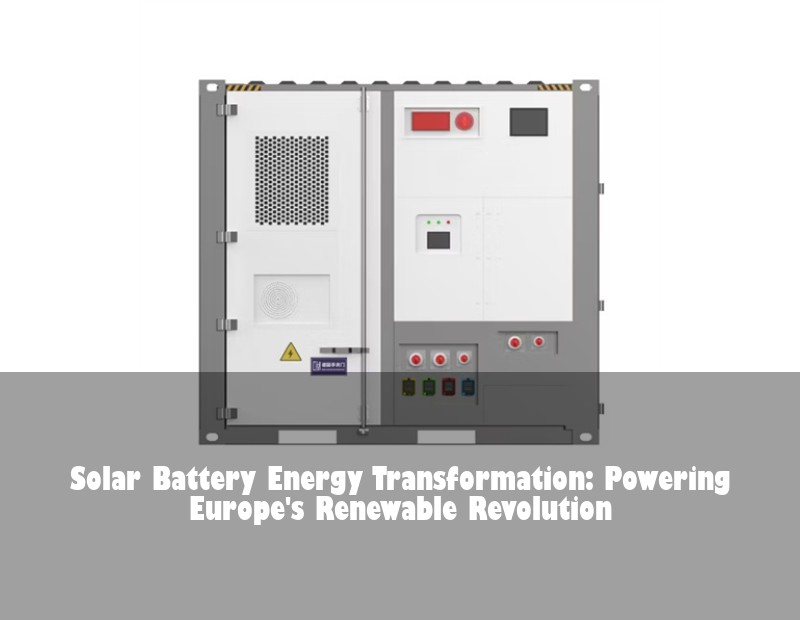
Imagine your home generating its own clean power during sunny days, then seamlessly switching to stored energy when clouds roll in. This isn't science fiction—it's the solar battery energy transformation reshaping Europe's energy landscape right now. As traditional grids strain under climate pressures, solar batteries emerge as the missing link in our renewable future. Let's explore how this technology turns passive consumers into active energy champions.
Table of Contents
- The Energy Tipping Point
- Solar Batteries: Beyond Basic Storage
- Germany's Real-World Success Blueprint
- Smart Grids & The Energy Democracy Revolution
- Your Home as a Power Plant
The Energy Tipping Point
Europe faces a perfect storm: energy prices surged 40% post-2022 while grid instability caused 15 million outage hours annually. But here's what keeps energy experts awake at night—solar panels alone can't solve intermittency. When clouds blanket Berlin or storms hit Barcelona, renewable generation plummets just when demand peaks. This mismatch creates what engineers call the "duck curve" dilemma:
| Challenge | Impact | Solar Battery Solution |
|---|---|---|
| Daytime solar surplus | Grid congestion & wasted energy | Absorb excess generation |
| Evening demand spikes | Fossil fuel dependency | Discharge stored energy |
| Grid failures | Business/health risks | Island mode operation |
The transformation starts when homeowners realize their solar panels produce raw potential, but batteries unlock actual resilience. "It's like having a rainwater tank during drought," says Dr. Elena Rossi, energy researcher at Politecnico di Milano. "Panels catch the rain, but batteries let you drink it when thirsty."
Solar Batteries: Beyond Basic Storage
Modern solar batteries aren't just containers—they're intelligent energy managers. Lithium iron phosphate (LFP) chemistry now dominates the European market, offering 6,000+ charge cycles with near-zero degradation. But what truly transforms energy use? Three game-changing capabilities:
- Time-Shifting: Buy low (€0.18/kWh night rate), store, use high (€0.42/kWh peak)
- Virtual Power Plants (VPPs): 500+ homes pooling batteries can match a coal plant's output
- AI Forecasting: Systems like SolarEdge's EnergyHub predict usage patterns and weather shifts
Suddenly, that box in your garage becomes an active grid participant. As Barcelona resident Marco Ferrer puts it: "My Tesla Powerwall negotiates with the grid better than my stockbroker!"
Germany's Real-World Success Blueprint
Let's visit the Bavarian village of Wildpoldsried, population 2,600. This community achieved 500% renewable energy independence through coordinated solar battery deployment. How? By transforming 180 households into a shared microgrid:

Image: Community battery storage installation ©BayWa r.e.
- 🏠 1.8MW combined storage capacity
- 🌞 83% self-consumption rate (vs. 30% battery-less systems)
- 💶 €120,000 annual revenue from grid services
- ⚡ 8-hour outage protection during 2021 floods
Data from Fraunhofer ISE confirms this model reduced grid strain by 73% while cutting carbon emissions equivalent to removing 340 cars annually. "We became our own utility company," beams mayor Klaus Löffler.
Smart Grids & The Energy Democracy Revolution
The magic happens when solar batteries talk to the grid. Spain's Cáceres province demonstrated this through dynamic voltage regulation. Batteries injected power within 0.2 seconds of voltage drops—faster than traditional infrastructure responds. This creates a self-healing grid where your home:
- Automatically isolates during outages
- Sells excess power during scarcity events
- Learns your EV charging patterns
The European Battery Alliance projects such systems will slash grid upgrade costs by €11 billion by 2030. But the real transformation? According to Portuguese grid operator REN, neighborhoods with >30% battery penetration see 90% fewer brownouts. That's not just convenience—it's critical for home medical devices and small businesses.
Your Home as a Power Plant
Now, let's address what you might be wondering: "Is this viable for MY roof?" Consider two key advancements:
- Costs plummeted 89% since 2010 (BNEF data)
- New EU regulations mandate bidirectional charging capability for all new buildings by 2025
An average Berlin household with 10kWh battery achieves payback in 6-8 years through:
- ⚡ 70-90% reduced grid imports
- 🔄 €200-500/year VPP participation fees
- 📉 Avoided peak pricing penalties
As more homeowners join this movement, we must ask: What happens when millions of these decentralized power plants start collaborating? Could your neighborhood become the next Wildpoldsried?
Ready to explore how your roof could join the solar battery energy transformation? Which energy challenge keeps YOU awake at night?
 Inquiry
 Online Chat