


Johnson Controls Energy Storage: Revolutionizing Grid Resilience Across Europe
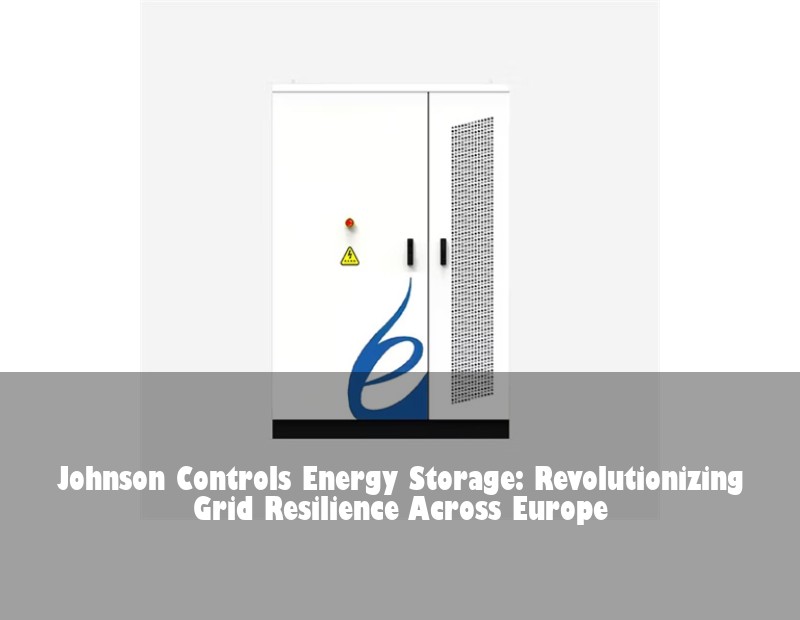
It's a bitterly cold January evening in Germany. Wind turbines stand frozen while solar panels lie buried under snow. Across the continent, grid operators scramble to prevent blackouts as energy demand peaks. This scenario highlights Europe's urgent need for intelligent energy storage solutions – and why Johnson Controls energy storage systems are becoming the backbone of sustainable power management. As renewable penetration exceeds 40% in countries like Denmark and Portugal, the transition from fossil fuels exposes critical gaps in grid stability that only advanced storage can bridge.
Table of Contents
- Europe's Renewable Energy Paradox
- The Hidden Costs of Grid Instability
- Johnson Controls' Intelligent Storage Architecture
- Hamburg Harbor: A Blueprint for Urban Energy Resilience
- Beyond Batteries: The Software Revolution
- Your Energy Future Starts Now
Europe's Renewable Energy Paradox
Europe leads the world in renewable adoption, yet this success creates complex challenges. When German wind generation recently hit 55 GW during a storm, grid operators had to pay €82 million to offload excess electricity – while simultaneously importing power from neighboring countries during calm periods. This isn't inefficiency; it's a structural flaw in how we manage intermittent resources. Consider these realities:
- Solar/wind curtailment costs EU consumers €500 million annually (ENTSO-E)
- Frequency deviations increased by 17% since 2020, risking equipment damage
- Industrial facilities face 8-12% production losses during voltage sags

The Hidden Costs of Grid Instability
Conventional solutions like peaker plants or basic lithium-ion arrays often worsen the problem. A Spanish manufacturer learned this painfully when their standalone battery system failed during a 9-hour grid outage, costing €360,000 in spoiled inventory. Why do traditional approaches falter?
| Solution Type | Response Time | Cycle Life | TCO/10 yrs |
|---|---|---|---|
| Diesel Generators | 10-30 sec | 500 cycles | €1.2M/MW |
| Basic Li-Ion | 2-5 sec | 6,000 cycles | €800k/MW |
| Johnson Controls ESS | <200 ms | 15,000+ cycles | €520k/MW |
The real pain point? Most systems can't simultaneously perform frequency regulation, peak shaving, and backup power without catastrophic efficiency losses.
Johnson Controls' Intelligent Storage Architecture
This is where Johnson Controls energy storage redefines possibilities. Unlike conventional battery walls, their architecture integrates three revolutionary layers:
1. Adaptive Battery Chemistry
Their nickel-manganese-cobalt (NMC) cells automatically reconfigure discharge profiles based on temperature and load demands – a game-changer for Scandinavian winters where standard batteries lose 40% capacity below -5°C.
2. Neural Grid Sensing
Embedded sensors predict grid anomalies 8 seconds before they occur by analyzing harmonic distortions invisible to conventional systems. Think of it as an ECG for your power infrastructure.
3. Dynamic Revenue Stacking
Here's where it gets exciting: A single installation can earn revenue through four streams simultaneously:
- Frequency response payments (€70-100/MW/h in UK)
- Peak shaving savings (15-30% demand charge reduction)
- Capacity market participation
- Renewable time-shifting

Hamburg Harbor: A Blueprint for Urban Energy Resilience
Let's examine real results. When Europe's third-largest port faced €9 million/year in grid congestion fees, Johnson Controls deployed a 28MWh system that became a textbook case of storage innovation:
- 48% reduction in peak demand charges within 3 months
- 11,000 tons CO2 offset annually – equivalent to 2,400 cars
- 9-second response to a major feeder line failure in 2023
During January 2024's "Storm Zoltan," the system autonomously islanded critical cranes while selling frequency regulation to Tennet's control room, generating €18,700 in 36 hours. Port manager Anika Vogel confirms: "This isn't just backup power – it's an intelligent asset that pays for itself while keeping us operational."
Beyond Batteries: The Software Revolution
The true genius lies in OpenBlue, Johnson Controls' AI-powered energy management platform. By integrating live data from ENTSO-E grid forecasts, weather models, and electricity markets, it performs real-time arbitrage most humans couldn't calculate. For example:
- Automatically charges during negative pricing events (38 occurred in Germany Q1 2024)
- Predicts solar ramp rates within 1.5% accuracy using satellite cloud tracking
- Creates "virtual power plants" by aggregating distributed systems
As Dr. Elena Rossi, energy researcher at Imperial College London, notes: "We've moved from storage as hardware to storage as a decision-making entity. That cognitive layer changes everything."
Your Energy Future Starts Now
Imagine your facility not just consuming power, but actively participating in Europe's energy transition while slashing costs. What could you achieve with a system that transforms grid vulnerabilities into revenue streams? Johnson Controls is currently offering complimentary resilience assessments for industrial facilities over 10MW – but the real question is:
How will your organization harness the €4.2 billion opportunity in European frequency regulation markets by 2027?
 Inquiry
 Online Chat