


How Much Climatic Energy Can Europe Realistically Harness for Solar Power?
Ever glance at a weather forecast and wonder—how much climatic energy could that cloud cover or sunshine actually translate to for your solar panels? As Europe accelerates its renewable transition, understanding the relationship between climate patterns and solar productivity isn't just academic; it's the key to unlocking energy security. Let’s break down how climatic variables impact solar potential and what that means for your energy strategy.
Table of Contents
- The Solar-Climate Paradox: More Sun ≠ More Energy?
- Quantifying Climatic Energy: Europe’s Solar Potential Dashboard
- Spain’s Solar Storage Revolution: A Climate-Energy Case Study
- Beyond Irradiance: The Hidden Climatic Variables That Impact ROI
- Next-Gen Climate Adaptation: How AI Is Rewriting Solar Harvesting Rules
- Your Climate, Your Energy: What’s Possible in Your Region?
The Solar-Climate Paradox: More Sun ≠ More Energy?
Solar panels thrive on photons, but climatic elements like ambient temperature, humidity, and particulate matter dramatically alter energy yield. For example:
- Heat traps energy: Panels lose 0.5% efficiency per 1°C above 25°C—critical in Mediterranean summers
- Clouds diffuse light: Thin cirrus clouds can boost output by 10% through light scattering effects
- Dust costs watts: Saharan dust events in Southern Europe reduce generation by 15-20% monthly

Image source: Unsplash
Quantifying Climatic Energy: Europe’s Solar Potential Dashboard
Not all sunlight is created equal. The map below compares climatic energy potential across key markets:
| Country | Avg. Annual kWh/kWp | Climatic Efficiency Factor* | Storage Adoption Rate |
|---|---|---|---|
| Germany | 950 | 0.82 | 68% |
| Spain | 1,550 | 0.78 | 42% |
| UK | 850 | 0.91 | 29% |
*Compares real-world output vs. lab conditions under local climate (Source: EU Energy Observatory)
Spain’s Solar Storage Revolution: A Climate-Energy Case Study
Extremadura Province faced a challenge: 2,800 annual sunshine hours were underutilized due to grid constraints and temperature fluctuations. The solution? Climate-adaptive storage:
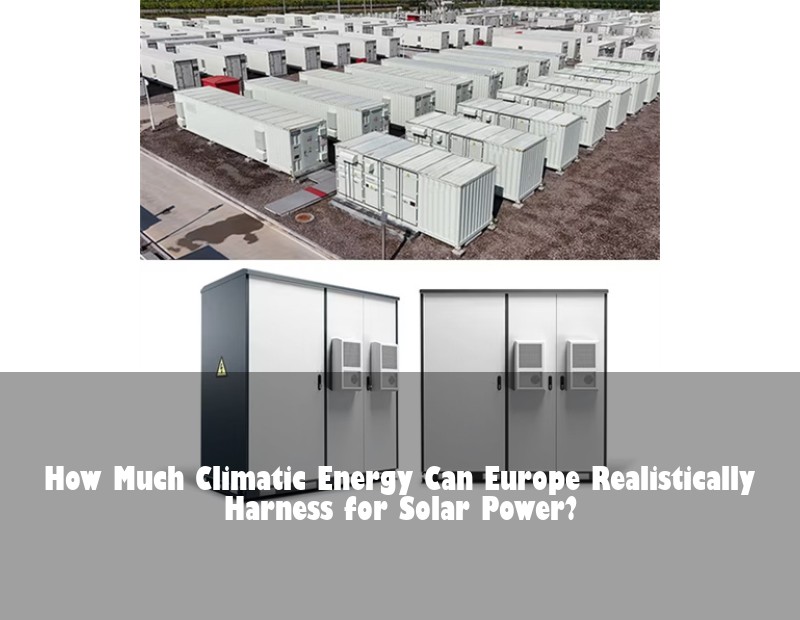
- Installed 220MWh liquid-cooled batteries across 47 solar farms
- Used historical weather data to create charging/discharging algorithms
- Result: 33% more grid-fed energy during peak heat events (2022 data)
This proves climatic energy isn't just about collection—it's about intelligent redistribution during suboptimal conditions.
Beyond Irradiance: The Hidden Climatic Variables That Impact ROI
Advanced solar operators now monitor micro-climatic factors most homeowners overlook:
- Albedo effect: Snow reflection boosts winter yield by 12% in Nordic regions
- Humidity hysteresis: Monsoon patterns reduce panel soiling more effectively than scheduled cleaning
- Wind cooling: Coastal installations in Portugal see 7% higher summer output than inland counterparts
As IRENA notes, "The next frontier in solar isn't bigger farms—it's climate-smarter operations."
Next-Gen Climate Adaptation: How AI Is Rewriting Solar Harvesting Rules
Machine learning now processes satellite weather data to predict hourly yield fluctuations:

Image source: Unsplash
German startup Solara reduced clipping losses by 18% during cloud-transit events by syncing panel angles with real-time cloud movement forecasts. This isn't sci-fi—it's 2024’s climate-energy optimization.
Your Climate, Your Energy: What’s Possible in Your Region?
We've shown how climatic energy varies across Europe—but what does this mean for your rooftop or commercial project? Could your location’s microclimate hold untapped potential that generic solar calculators miss?
 Inquiry
 Online Chat