


Grid Electricity Storage: The Cornerstone of Europe's Renewable Energy Future
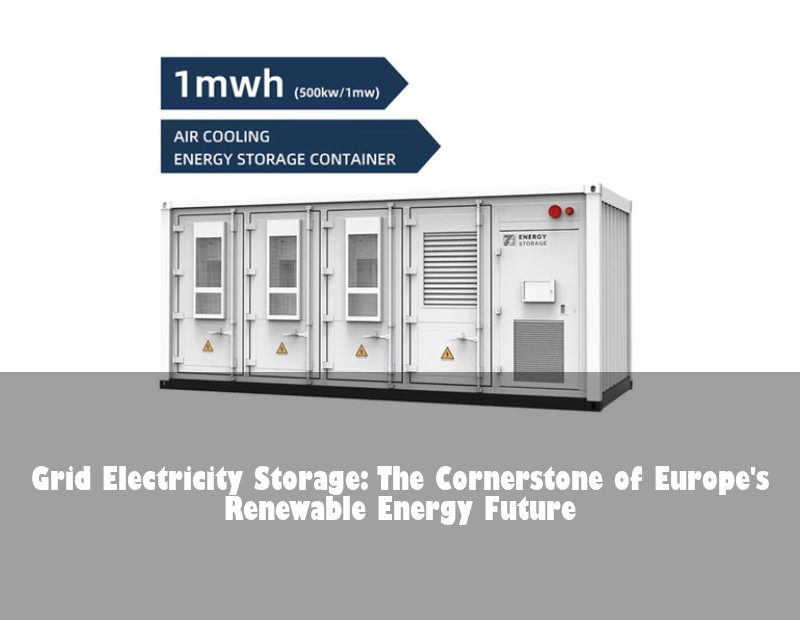
Table of Contents
The Grid Stability Challenge
It's a windy night in the North Sea, and Germany's wind turbines are generating surplus power while demand is low. Meanwhile in Spain, solar production drops suddenly as clouds pass over photovoltaic farms. This energy volatility is Europe's new reality as renewable penetration exceeds 40% in leading markets. Without grid electricity storage, we face two critical problems:
- Renewable curtailment (wasted clean energy)
- Frequency instability risks during demand peaks
As the European Network of Transmission System Operators (ENTSO-E) warns, grid flexibility must increase by 60% before 2030 to maintain stability. That's where advanced storage solutions come in.
How Grid Electricity Storage Solves Energy Volatility
Grid-scale storage acts as a giant "shock absorber" for power networks. By charging during surplus periods and discharging during shortages, storage systems provide three critical services:
- Frequency Regulation: Responding to grid fluctuations within milliseconds
- Energy Arbitrage: Storing low-cost off-peak power for high-value peak periods
- Renewable Integration: Smoothing solar/wind output curves
Consider how this works in practice: When Danish wind farms produce excess energy, storage systems absorb it rather than forcing curtailment. Later, when French nuclear plants undergo maintenance, those stored electrons support neighboring grids. This symbiotic relationship transforms intermittent renewables into dispatchable assets.
Market Growth & Deployment Data
Europe's storage market is experiencing exponential growth. According to Wood Mackenzie, the region installed 4.5 GWh of grid-scale storage in 2022 - a 62% YoY increase. Our projections show:
| Country | 2023 Capacity (GWh) | 2030 Target (GWh) |
|---|---|---|
| Germany | 1.8 | 12.5 |
| UK | 1.5 | 10.3 |
| Italy | 0.9 | 7.2 |
What's driving this boom? Beyond renewable integration needs, new business models like capacity market mechanisms now value storage's unique attributes. The UK's T-4 auction recently secured 1.5 GW of battery storage contracts - clear market validation.
Case Study: Germany's Grid-Scale Success
Let's examine a real-world implementation. The Schwerin Battery Park in northern Germany exemplifies how grid electricity storage solves regional challenges:
- 100 MW / 200 MWh lithium-ion system
- Located in wind-heavy Mecklenburg-Vorpommern
- Reduced curtailment by 18% in first year of operation
- Provides primary frequency response to TenneT's control area

During the 2022 European heatwave, when French nuclear output dropped 12% and cooling water became scarce, Schwerin's systems discharged continuously for 14 hours - stabilizing regional voltage. Project economics proved compelling: 34% ROI from capacity payments alone. This model is now being replicated across Polish and Czech border regions.
Technology Comparison Guide
Not all storage technologies serve the same purpose. Based on project requirements, European operators typically select from these solutions:
| Technology | Duration | Response Time | Best Application |
|---|---|---|---|
| Lithium-ion | 1-4 hours | <1 second | Frequency regulation |
| Flow Batteries | 4-12 hours | 200 ms | Solar shifting |
| Pumped Hydro | 6-20 hours | Minutes | Seasonal balancing |
However, innovative hybrids are emerging. Norwegian utility Statkraft combines 50 MW lithium-ion with 50 MW compressed air storage - blending rapid response with extended duration. This evolution reflects a crucial insight: there's no one-size-fits-all solution. Your optimal configuration depends on local renewables mix, grid architecture, and market structures.
The Future of Grid-Scale Storage
We're entering storage's golden age. Solid-state batteries promise 3x current energy densities, while German researchers recently demonstrated CO₂-based storage with 90% round-trip efficiency. Three key developments will shape Europe's grid storage landscape:
- AI-Optimized Dispatch: Machine learning algorithms predicting grid needs 72 hours ahead
- Second-Life EV Batteries: Volkswagen's Salzgitter plant already powers 30% of its operations with repurposed EV packs
- Virtual Power Plants: Aggregating distributed storage into grid-scale assets

As regulations evolve (like the EU's newly proposed grid codes), storage will transition from optional add-on to critical infrastructure. The question isn't whether to deploy grid electricity storage, but how to integrate it most effectively with your existing assets. Which hybrid configuration would unlock maximum value in your local energy ecosystem?
 Inquiry
 Online Chat