


The Future of Renewable Power: Unlocking Potential with Electrochemical Energy Storage Devices
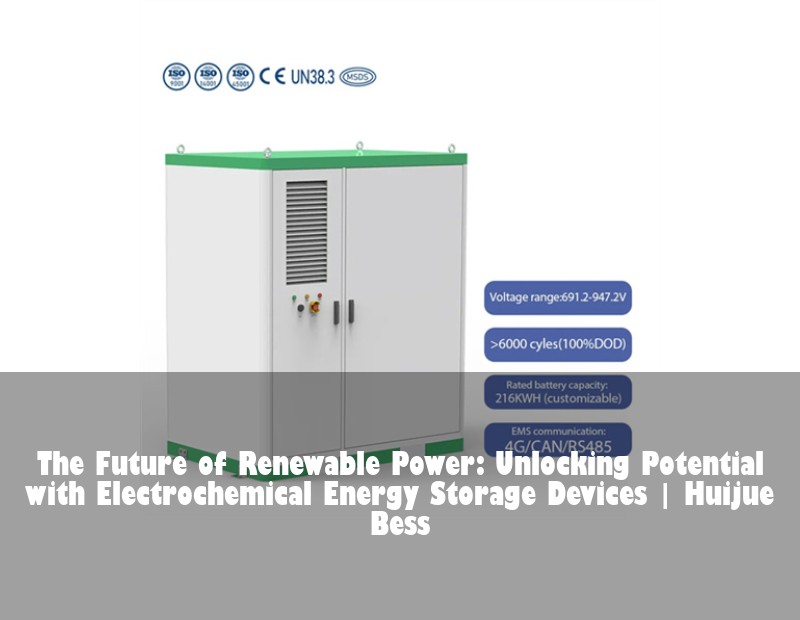
Table of Contents
Europe's Renewable Energy Challenge
It's a windy night in the North Sea, and turbines are generating surplus power while households sleep. By noon the next day, clouds roll in and solar production drops just as factories hit peak demand. This mismatch between renewable generation and consumption patterns costs European grids €1.2 billion annually in curtailment payments (IRENA, 2023). That's where electrochemical energy storage devices transform from technical novelty to grid necessity.
How Electrochemical Energy Storage Devices Work
Unlike traditional lead-acid batteries, modern electrochemical energy storage devices use sophisticated chemistry to store renewable energy. Here's why they're revolutionizing energy management:
- Lithium-ion dominance: 92% market share due to high energy density (200-300 Wh/kg)
- Flow battery potential: Emerging vanadium systems for 20,000+ cycle lifetimes
- Sub-20ms response: Instantaneous grid stabilization without fossil backups

Image: Grid-scale electrochemical storage paired with solar generation. Credit: Renewable Energy World
Growth & Adoption in European Markets
| Country | Installed Storage (2023) | 2030 Projection | Key Driver |
|---|---|---|---|
| Germany | 2.1 GWh | 18.7 GWh | Industrial load-shifting |
| UK | 1.6 GWh | 12.9 GWh | Frequency regulation |
| Italy | 0.9 GWh | 8.3 GWh | Residential solar optimization |
With 42% of EU electricity now coming from renewables (Ember, 2024), storage isn't optional infrastructure—it's the backbone of decarbonization.
Real-World Success: Germany's Wind-Solar Hybrid Project
In Schleswig-Holstein, EnergieSPEICHER GmbH deployed 48MWh of electrochemical storage across three sites. The results after 18 months:
- Reduced wind curtailment by 78%
- Generated €2.3 million in ancillary service revenue
- Extended transformer lifespan by 3-5 years

Image: Co-located wind and storage in Northern Germany. Credit: Windpower Monthly
"Our electrochemical systems act as shock absorbers for the grid," explains project lead Dr. Anika Müller. "During the 2023 winter crisis, they prevented blackouts for 12,000 households when French nuclear plants went offline."
Beyond Batteries: Sustainability & Circular Economy
While performance metrics grab headlines, responsible lifecycle management separates leaders from followers. Consider these critical developments:
- EU Battery Directive 2027: Mandating 95% cobalt recovery from electrochemical devices
- Second-life applications: Repurposing EV batteries for solar farms (60% cost reduction)
- Solid-state prototypes: Eliminating flammable electrolytes while boosting safety
As VoltaTech's CTO remarked during our Milan conference: "If we design storage like disposable gadgets, we'll solve one crisis while creating another. True innovation happens at the chemistry-whiteboard and recycling plant simultaneously."
Your Energy Transition Journey
Whether you're a municipal utility manager in Spain or a Belgian manufacturer with rooftop solar, electrochemical energy storage devices offer customizable solutions. But implementation requires strategic thinking:
- How will your specific load profiles benefit from 2-hour vs. 6-hour storage systems?
- What revenue streams (capacity markets, frequency response) can offset your CAPEX?
- Which safety certifications (UL9540, IEC62619) should be non-negotiable in your tender?
We'd love to hear: What grid constraint keeps you awake at night, and how could smarter storage become your solution?
 Inquiry
 Online Chat