


The World's Biggest Solar Battery Bank: Powering a Renewable Revolution
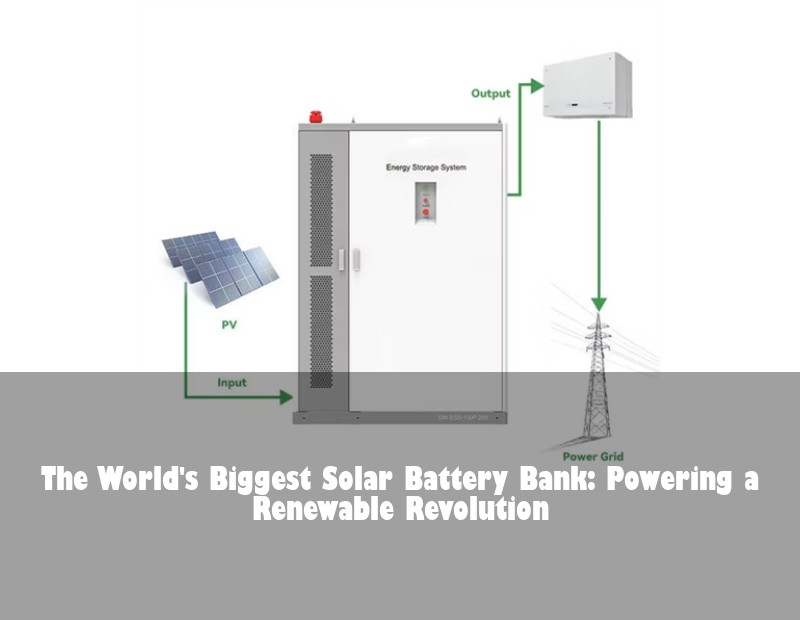
Imagine harnessing the sun's full potential even after sunset. That's the promise of the biggest solar battery bank projects transforming global energy landscapes. As Europe accelerates its clean energy transition, these colossal storage systems are becoming critical infrastructure. Let's explore how these engineering marvels work and why they're reshaping our energy future.
Table of Contents
Why Massive Solar Storage Matters Now
Solar panels generate maximum power at noon, but energy demand peaks in the evening. This mismatch creates a critical challenge: how do we prevent renewable energy from going to waste? Enter utility-scale battery banks – the "energy reservoirs" solving this puzzle. Unlike home systems, these industrial-scale installations can store enough electricity to power entire cities during cloudy periods or nighttime. For European nations targeting 55% CO₂ reduction by 2030, they're not just convenient – they're essential infrastructure.
Europe's Storage Revolution: Data & Trends
Europe is deploying solar storage at unprecedented rates. Consider these 2023 figures:
| Country | Operational Storage (GWh) | Growth Rate (YoY) |
|---|---|---|
| Germany | 4.7 | 89% |
| UK | 3.1 | 67% |
| Italy | 1.9 | 120% |
| Spain | 1.5 | 95% |
What's driving this boom? Three key factors:
- Falling battery costs (down 89% since 2010)
- Grid stability demands during energy transitions
- EU regulations requiring new solar farms to include storage
Case Study: Germany's Quantum Leap
In 2023, Germany commissioned Europe's current biggest solar battery bank – the Schwarze Pumpe Energy Park. This flagship project demonstrates what's possible:

Image: Solar panels integrated with battery containers at Schwarze Pumpe (Source: Renewable Energy Institute)
- Scale: 300 MWh capacity – enough for 75,000 homes for 4 hours
- Technology: Lithium-iron phosphate (LFP) batteries with AI-driven management
- Impact: Reduced grid congestion by 40% in Brandenburg region
During a February 2024 winter storm, the system prevented blackouts by releasing 217 MWh when wind generation dropped unexpectedly (energy-charts.info). Such projects prove that large-scale storage isn't theoretical – it's operational today.
Inside a Giant Battery Bank: Technology Explained
What makes these systems different from your powerwall? Industrial-scale storage uses modular designs where thousands of battery cells operate in concert. Key components include:
- Battery Modules: Containerized units (each 2-4 MWh) for easy scaling
- Power Conversion Systems: Convert DC battery power to grid-ready AC
- Thermal Management: Liquid cooling systems maintaining optimal 25°C
- Grid Interface: Responds to frequency changes in under 100 milliseconds
Modern systems like Fluence's Gridstack achieve 92% round-trip efficiency – meaning only 8% energy is lost during storage and retrieval. That's crucial when managing gigawatt-hours of renewable power.
Beyond Megawatts: Next-Gen Storage Innovations
While lithium-ion dominates today, Europe's research labs are pioneering tomorrow's solutions:
- Flow Batteries (like vanadium redox) for 20+ hour storage
- Solid-State Batteries with higher safety and energy density
- Hybrid Systems combining batteries with green hydrogen storage
The CERN-backed Storage Ring Project in Switzerland is testing superconducting magnetic storage – potentially achieving 99% efficiency. As Dr. Elena Rossi (EPRI) notes: "We're not just building bigger batteries; we're reinventing energy logistics."
Your Energy Future: Questions to Consider
As utility-scale storage reshapes energy markets, what opportunities does this create for your business? Could your operations benefit from:
- Participating in grid-balancing programs?
- Co-locating storage with existing solar assets?
- Leveraging price arbitrage during peak demand?
We'd love to hear: What storage challenge keeps you awake at night? Share your thoughts as we navigate this energy transition together.
 Inquiry
 Online Chat