


Choosing the Right Battery for Storing Solar Energy: A Guide for European Homes & Businesses
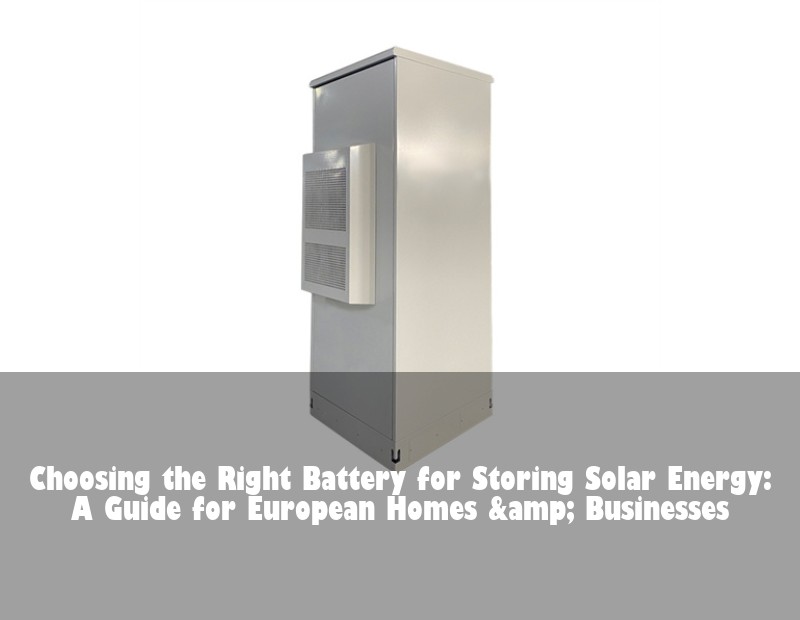
The shift towards renewable energy in Europe isn't just a trend; it's a necessity driven by climate goals and soaring electricity costs. While solar panels are a common sight, harnessing the sun's full potential requires a critical partner: the battery for storing solar energy. This technology transforms solar from a daytime-only solution into a 24/7 energy source. Let's explore how these batteries empower energy independence across Europe.
The Solar Storage Imperative: Why Every Kilowatt-Hour Counts
your solar panels generate peak power at midday, often when your home or business uses the least energy. Without storage, this valuable surplus flows back to the grid, often for minimal compensation. Come evening, when demand and grid prices surge, you're forced to buy expensive electricity back. This mismatch is the core challenge solar households face.
Data from the International Renewable Energy Agency (IRENA) highlights Europe's rapid solar adoption. Yet, studies show households without storage only use 30-50% of their self-generated solar power on average. A battery for storing solar energy bridges this gap, dramatically increasing self-consumption rates to 60-80% or more. This isn't just about convenience; it's about maximizing the return on your solar investment and insulating yourself from volatile energy markets.

Image Source: Unsplash - Residential Solar & Battery Integration
Demystifying the Technology: How Your Solar Battery Powers Your Night
Think of your solar battery as a sophisticated energy reservoir. Here's the simplified cycle:
- Generation: Solar panels convert sunlight into direct current (DC) electricity.
- Conversion: An inverter transforms DC into usable alternating current (AC) for your appliances.
- Storage: Excess AC power is converted back to DC (by the battery's internal inverter/charger) to charge the battery bank.
- Discharge: When solar production drops (evening, night, cloudy periods), the battery discharges stored DC power.
- Powering Your Home: The battery's inverter converts the discharged DC power back into AC, seamlessly powering your home or business.
Modern systems are intelligent. They monitor energy production, consumption patterns, and even grid tariffs (where variable pricing exists) to automatically optimize when to charge, store, and discharge, ensuring you get the most economic benefit.
Choosing Your Champion: Key Battery Features Explained
Not all batteries are created equal. When selecting a battery for storing solar energy, consider these crucial factors relevant to the European context:
- Capacity (kWh): The total amount of energy stored. Think: How large is your energy "tank"? (e.g., 5kWh, 10kWh, 15kWh). Size depends on your daily consumption and solar production.
- Power (kW): How much electricity the battery can deliver at once. This determines how many high-power appliances (like kettles or heat pumps) it can run simultaneously.
- Depth of Discharge (DoD): The percentage of the battery's capacity you can safely use (e.g., 90% DoD means only 10% is kept as reserve). A higher DoD means more usable energy.
- Efficiency (Round-Trip): The percentage of energy put *into* the battery that you can then get *out* (e.g., 95% efficiency means 5% is lost in charging/discharging heat). Higher is better.
- Chemistry:
- Lithium-Ion (NMC/LFP): Dominant technology. LFP (Lithium Iron Phosphate) is increasingly popular in Europe for its superior safety, longer lifespan (>6000 cycles), and excellent thermal stability, even if slightly less energy-dense than NMC. NMC offers higher density.
- Lead-Acid: Older tech, lower cost upfront but shorter lifespan, lower DoD, and lower efficiency. Less common for new solar+storage installs in Europe.
- Lifespan & Warranty: Measured in cycles (full charge/discharge) or years. Quality European-marketed batteries typically offer 10-year warranties guaranteeing a certain remaining capacity (e.g., 70% after 10 years).
- Scalability: Can you easily add more battery units later if your needs grow?
- Smart Management & Grid Interaction: Crucial for Europe! Does the system integrate with smart home platforms? Can it participate in grid services (like peak shaving or Virtual Power Plants - VPPs - where regulations allow)?
- Safety Certifications: Look for mandatory CE marking and relevant IEC standards (e.g., IEC 62619).
Powering Progress: A German Case Study - Volkshaus GmbH
Let's move beyond theory. Volkswagen Gebrauchte (used car division) in Germany faced rising operational costs and a commitment to sustainability. They installed a large solar array (245 kWp) paired with a 192 kWh LFP battery storage system at one of their logistics centers.
The Challenge: High daytime energy consumption for operations, coupled with unused solar potential during peak generation hours.
The Solution: A bespoke battery for storing solar energy solution designed to shift solar surplus to cover evening operational peaks and charge their fleet of electric logistics vehicles overnight.
| Metric | Before Storage | After Storage |
|---|---|---|
| Solar Self-Consumption | ~35% | >85% |
| Grid Electricity Purchased (Peak Hours) | High | Reduced by ~70% |
| CO2 Footprint | Estimated Baseline | Reduced by ~120 tonnes/year |
| Payback Period | N/A | Estimated under 7 years (factoring in energy savings & German incentives) |
"The battery storage system was key to maximizing our solar investment," stated the facility manager. "It turns our site into a more self-sufficient power plant, drastically cuts our peak grid costs, and directly supports our e-fleet transition." (Source: Volkswagen Newsroom - Project Examples).
The European Storage Horizon: What's Next?
The future for solar batteries in Europe is exceptionally bright, driven by:
- Falling Costs: Fraunhofer ISE reports continued, significant decreases in lithium-ion battery pack prices – crucial for wider adoption.
- Rising Electricity Prices: Volatility and high prices enhance the economic case for self-consumption.
- Supportive Policies: Many EU countries offer grants, low-interest loans, or tax benefits for solar+storage systems (e.g., KfW in Germany, tax credits evolving across EU states). Net metering schemes are evolving towards favoring storage.
- Vehicle-to-Grid (V2G) & Smart Grids: Emerging technologies allow compatible EVs to act as grid-stabilizing assets. Home batteries will increasingly integrate into these smart ecosystems. The EU's 'Fit for 55' package further accelerates this shift.
- LFP Dominance: Expect LFP chemistry to become even more prevalent due to its safety and long-life advantages, perfectly suited for the stationary storage market.

Image Source: Unsplash - Smart Home Energy Ecosystem
Ready to Harness Your Solar Power, Day and Night?
Investing in a high-quality battery for storing solar energy is no longer just an eco-conscious choice; it's a strategic energy resilience and financial decision for European homes and businesses. The technology is mature, reliable, and increasingly economical. The case for maximizing your solar investment and taking control of your energy future is compelling.
What energy independence goals could a solar battery help *you* achieve in the next year? Whether it's slashing your electricity bills, ensuring backup power, reducing your carbon footprint, or preparing for an EV, the journey towards greater energy autonomy starts with understanding your storage potential.
 Inquiry
 Online Chat