


Unlock Energy Freedom: Your Essential Guide to Battery ESS for Home Use
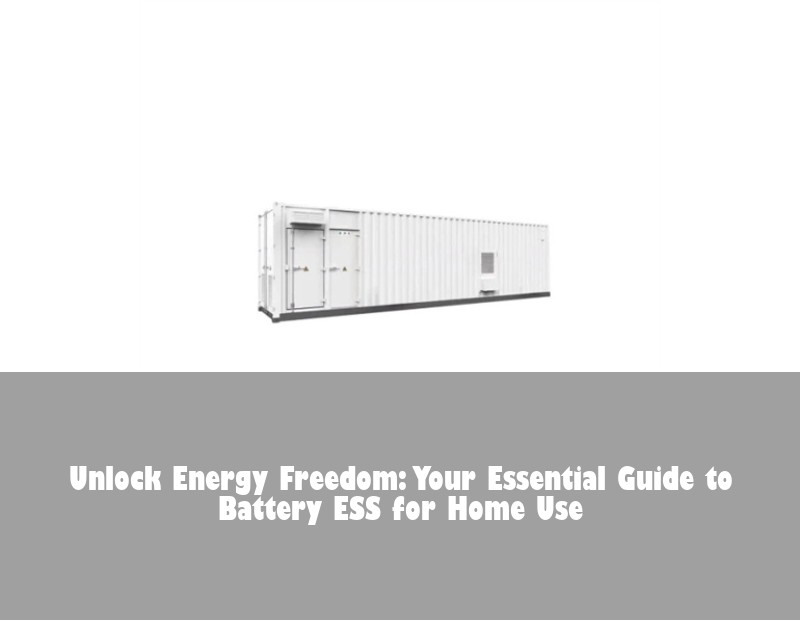
Table of Contents
- The Rising Energy Revolution in European Homes
- How Battery ESS for Home Use Actually Works
- Why European Households Are Switching to Battery ESS Now
- Real Results: A German Family's Battery ESS Transformation
- Choosing Your Perfect Home Battery ESS: Key Considerations
- DIY or Pro Install? Navigating Your Home ESS Setup
- The Bright Future of Home Energy Storage
The Rising Energy Revolution in European Homes
It's 8 PM in Berlin, electricity prices just surged to €0.45/kWh, but your home hums along unaffected. How? You're drawing power from your battery ESS—a silent energy guardian that's transforming how European households consume electricity. Across Germany, Spain, and Italy, homeowners are installing these systems not just for backup, but as intelligent energy hubs. The European residential battery market grew 62% in 2023 alone, with over 500,000 new installations—a clear signal that battery ESS for home use has moved from niche to necessity.
 Image: Renewable energy integration in European homes | Source: Unsplash
How Battery ESS for Home Use Actually Works
Think of your home battery system as a personal energy savings account. Here's what happens minute-by-minute:
- Solar panels feed excess energy to your battery instead of the grid during peak production
- Intelligent software predicts usage patterns and weather to optimize charging cycles
- During price surges or outages, stored power automatically powers critical circuits
The secret sauce? Modern battery chemistry. Unlike older lead-acid systems, today's lithium iron phosphate (LiFePO4) batteries offer 6,000+ cycles with minimal degradation—meaning your €10,000 investment could serve your home for 15+ years. Here's how different technologies compare:
| Technology | Cycle Life | Depth of Discharge | European Market Share |
|---|---|---|---|
| LiFePO4 | 6,000+ cycles | 90% | 68% |
| NMC | 4,000 cycles | 80% | 27% |
| Lead-Acid | 1,200 cycles | 50% | 5% |
Why European Households Are Switching to Battery ESS Now
Remember the 2022 energy crisis? That wasn't a blip—it was a wake-up call. Three converging factors make battery ESS essential today:
- Soaring tariffs: EU electricity prices increased 40% on average since 2021 (Eurostat data)
- Grid instability: 32% of EU households experienced outages in 2023
- Policy tailwinds: Germany's KfW grants cover up to 30% of installation costs
But here's what most homeowners don't realize: Modern systems like Solar Pro's Horizon Series actually earn money through virtual power plant (VPP) programs. By allowing grid operators to access your stored energy during peak demand, you receive compensation—turning your battery from cost center to revenue generator.
Real Results: A German Family's Battery ESS Transformation
The Hoffmanns in Bavaria prove this isn't theoretical. After installing a 10kWh system in 2022:
- Reduced grid dependence by 78% despite having only 8 solar panels
- Cut annual electricity costs from €1,850 to €310
- Earned €420 in VPP participation fees last winter
 Image: Real-time energy monitoring system | Source: Unsplash
"Our battery pays for itself in 6.5 years," says Klaus Hoffmann. "But the real value? Knowing we're protected during blackouts while reducing our carbon footprint." (Source: Fraunhofer Institute Case Study)
Choosing Your Perfect Home Battery ESS: Key Considerations
Not all systems are created equal. When evaluating options, ask these critical questions:
- Scalability: Can you add modules later as needs grow?
- Software intelligence: Does it integrate with local energy pricing data?
- Cycling capability: How many full discharges can it handle before degradation?
Pro tip: Look for systems with at least 10-year warranties and >90% round-trip efficiency. The sweet spot for most European homes is 8-12kWh capacity—enough to cover evening energy needs without oversizing.
DIY or Pro Install? Navigating Your Home ESS Setup
While some manufacturers offer plug-and-play options, consider this: Professional installation ensures:
- Compliance with EU's EN 62477-1 safety standards
- Optimal placement for thermal management (batteries hate garages!)
- Seamless integration with existing solar and grid connections
In Germany, certified installers complete typical setups in 4-6 hours. The peace of mind? Priceless when dealing with high-voltage systems.
The Bright Future of Home Energy Storage
What's coming next excites us most: Solid-state batteries entering pilot testing in Scandinavia promise 50% more density in the same footprint. Vehicle-to-home (V2H) technology—already available in Nissan Leaf models—will let your EV power your home during outages. And AI-driven systems will soon predict your energy needs down to the minute.
But here's our burning question for you: If your home could generate, store, and trade electricity autonomously—what would that newfound energy freedom enable in your life?
 Inquiry
 Online Chat