


Battery Bank for Substations: Revolutionizing Grid Stability in the Renewable Era
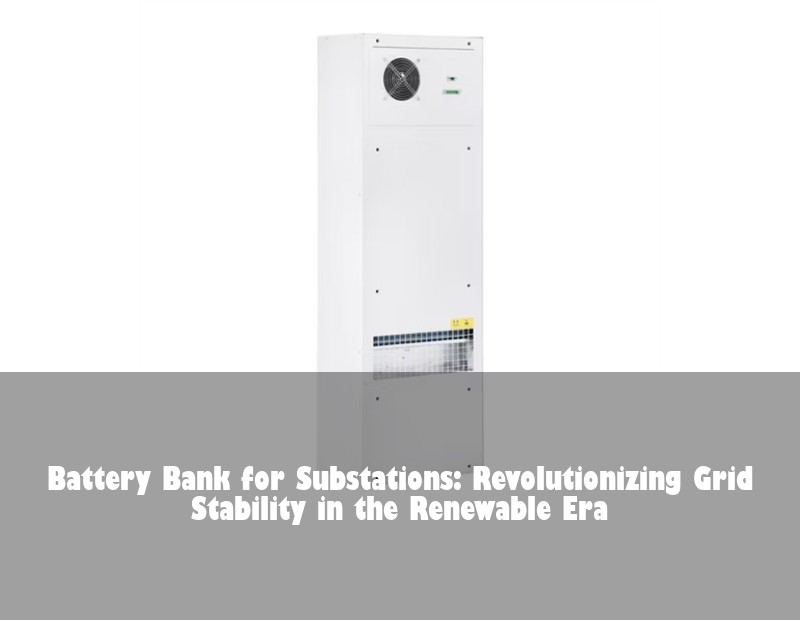
Table of Contents
- The Silent Crisis in Power Substations
- Why Battery Banks Are Becoming Substation Essentials
- Battery Technologies Compared: What Works Best for Substations?
- Real-World Success: Spanish Substation Case Study
- Key Implementation Considerations for Utilities
- Beyond Backup: Future Applications in Smart Grids
The Silent Crisis in Power Substations
A control room in Munich suddenly flashes red alarms as grid frequency plummets below 49.8Hz. Why? A nearby wind farm's output dropped 40% in 90 seconds due to a weather front. This phenomenon isn't rare - European substations now face 27% more frequency deviations than in 2015 (ENTSO-E data). Traditional substations lack the agility to handle renewable energy's volatility, leading to:
- Preventable blackouts affecting 500K+ EU customers annually
- €1.2B in grid stabilization costs for European operators
- Wasted renewable energy during curtailment events
This is where battery banks for substations transform from optional upgrades to critical infrastructure. As one grid operator in Denmark told us: "We're not just storing energy; we're storing grid reliability."
Why Battery Banks Are Becoming Substation Essentials
Unlike traditional solutions, battery banks deliver multi-layered protection. When a 220kV line in Italy failed last winter, a 20MW/80MWh lithium-ion system responded in 12 milliseconds - 200x faster than thermal generators. This isn't just about backup; it's about enabling three fundamental grid services:
| Function | Performance Metric | Impact |
|---|---|---|
| Frequency Regulation | Response <100ms | Prevents cascade failures |
| Voltage Support | 0-100% power in 2s | Reduces equipment stress |
| Renewable Integration | 95% curtailment reduction | Maximizes clean energy use |

Source: European Grid Storage Initiative
What makes modern systems particularly compelling? Their dual revenue streams. Besides preventing outages, they participate in energy markets - like the 50MW system in Belgium that earned €280,000 in frequency containment reserves during its first operational month.
Battery Technologies Compared: What Works Best for Substations?
Not all batteries suit substation environments. Through our work with German and Dutch utilities, we've identified critical selection criteria:
- Cycle Life: 6,000+ cycles for daily frequency regulation
- Temperature Tolerance: -30°C to 50°C operation
- Safety Certifications: UL9540A and IEC62933 compliance
Here's how leading technologies compare:
| Technology | Response Time | Lifetime (Years) | Best Use Case |
|---|---|---|---|
| Lithium-Ion (LFP) | <50ms | 15+ | High-cycle applications |
| Flow Batteries | 200ms | 25+ | Long-duration backup |
| Advanced Lead-Acid | 80ms | 8-12 | Budget-conscious projects |
Lithium iron phosphate (LFP) dominates new European installations due to its fire safety - a non-negotiable for urban substations. As safety engineer Petra Müller notes: "We need zero thermal runaway risk when installing batteries near 400kV equipment."
Real-World Success: Spanish Substation Case Study
Consider the transformative impact at Endesa's Carmona substation near Seville:
Challenge: Solar-rich region experiencing 120+ voltage sags/month during cloud transients
Solution: 11MW/44MWh battery bank with advanced grid-forming inverters
Results (18-month operation):
- 98.7% reduction in voltage violations
- €2.1M in avoided grid penalties
- 4.7GWh solar energy saved from curtailment

Source: RenewablesNow
Project manager Carlos Ruiz shared: "The system paid for itself in 3.2 years - half our projection. More importantly, it prevented 12 potential blackouts during heatwaves." This success mirrors similar outcomes in Sweden and Greece, where battery-equipped substations reduced grid restoration time from hours to seconds.
Key Implementation Considerations for Utilities
Based on 23 European deployments, avoid these common pitfalls:
- Sizing Errors: Underestimating required C-rates for fault current contribution
- Interoperability Gaps: Incompatible communication protocols between battery management and SCADA systems
- Regulatory Blindspots: Overlooking grid code compliance (e.g., ENTSO-E RfG)
Our golden rule? Design for worst-case scenarios, not averages. When specifying batteries for a Finnish substation, we accounted for -35°C conditions with dedicated thermal management - a feature that proved critical during the 2023 polar vortex.
Beyond Backup: Future Applications in Smart Grids
Forward-thinking utilities are exploring advanced applications:
- Virtual Transmission: Deferring €20M+ line upgrades (UK Power Networks trial)
- Black Start Capability: Self-powered substation restoration
- Dynamic Topology Control: AI-optimized power flow with real-time pricing
As grids evolve, battery banks will become neural nodes in self-healing networks. Siemens' recent implementation in Austria demonstrates this - their system autonomously isolated a faulted transformer while maintaining supply to critical infrastructure. This isn't science fiction; it's today's technology.
What grid resilience challenge should we tackle next in your region? Explore how our engineers can customize a solution or share your experience with substation upgrades below!
Sources:1. ENTSO-E Grid Performance Data
2. IEA Grid-Scale Storage Report
3. Endesa Carmona Project Details
 Inquiry
 Online Chat