


Understanding Your Power Needs: The Versatility of a 7 kVA Solar System Load Capacity
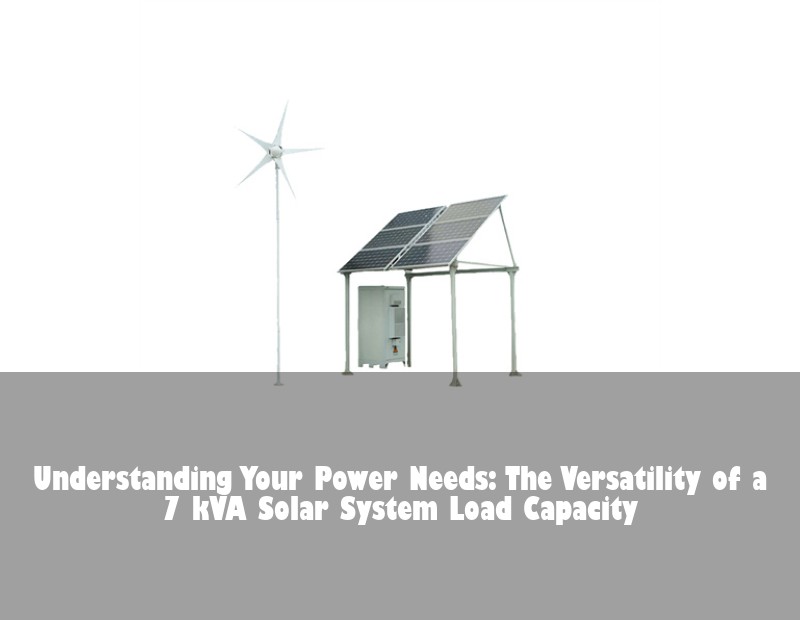
Ever wondered how much power your home or small business actually needs? Across Europe, from bustling German towns to sunny Spanish villas, a common challenge emerges: matching renewable energy generation to real-world electrical demand. That's where understanding the 7 kVA solar system load capacity becomes crucial. This capacity represents a significant sweet spot, offering robust power for many households and small enterprises while efficiently harnessing solar potential. Let's explore how this system size translates into practical power for your daily life.
Table of Contents
- Decoding kVA: What Does 7 kVA Really Mean for You?
- The Real Power: What Can a 7 kVA Solar System Actually Run?
- Sunshine & Savings: A German Household Case Study
- Beyond the Sun: The Essential Role of Battery Storage
- Maximizing Your 7 kVA Investment: Load Management & Efficiency
- Is a 7 kVA Solar System the Right Step Towards Your Energy Independence?
Decoding kVA: What Does 7 kVA Really Mean for You?
While often used interchangeably with kW, kVA (kilo Volt-Ampere) specifically measures the apparent power in an electrical system. It combines actual power (kW, doing useful work like heating or spinning motors) and reactive power (kVAR, needed for magnetic fields in devices like fridges or pumps). For most European households operating at a power factor (PF) between 0.8 and 0.95, a 7 kVA system translates to roughly 5.6 kW to 6.65 kW of usable real power. This distinction is vital for sizing inverters and ensuring stable operation when multiple inductive loads start simultaneously.
Think of it like a beer glass: kVA is the total volume (liquid + foam), while kW is just the liquid beer you can actually drink. A 7 kVA inverter is designed to handle that total volume of electrical 'flow' safely.
 Image: Modern solar inverters clearly display power metrics like kVA and kW. Source: Pexels (Licensed for commercial use).
The Real Power: What Can a 7 kVA Solar System Actually Run?
A well-designed 7 kVA solar system, typically paired with 6-8 kWp of solar panels, offers substantial load-carrying capability. This capacity comfortably handles the combined demands of:
- Core Household Essentials: Refrigeration, LED lighting, efficient water pumps, laptops, TVs, and Wi-Fi routers run continuously with minimal impact.
- Major Appliances (Sequentially): A 1.5HP air conditioner (approx. 1.2 kW running), a washing machine (0.5-1.2 kW), a microwave (0.8-1.2 kW), or an electric kettle (1.5-3 kW) can be operated, though often not all at the exact same moment without careful planning.
- Small Business Needs: Powering point-of-sale systems, multiple computers, lighting, and ventilation for a small shop or office is well within scope.
Critical to managing this capacity is understanding surge currents. Motors in fridges, ACs, or pumps can demand 3-7 times their running power for a few seconds on startup. A quality 7 kVA inverter is engineered to handle these surges, preventing overload trips under normal operating conditions.
| Appliance | Running Power (Watts) | Surge Power (Watts) | Runtime on Solar/Battery* |
|---|---|---|---|
| LED Lights (10) | 100 | 100 | All Day |
| Refrigerator (A+++) | 150 | 1000 | Cycling |
| Laptop | 60 | 60 | All Day |
| 55" LED TV | 100 | 100 | Evenings |
| Washing Machine (Heavy) | 2200 (Heating) | - | Scheduled (Sunny) |
| Dishwasher | 1800 (Heating) | - | Scheduled (Sunny) |
| 1.5HP Inverter AC | 800-1200 | 2500-3500 | Evenings/Pk Sun |
Sunshine & Savings: A German Household Case Study
Consider the Müller family in Freiburg, Germany. Facing rising grid costs (~€0.35/kWh) and motivated by sustainability, they installed a 7.5 kWp solar array with a 7 kVA hybrid inverter and a 12.8 kWh lithium battery in Q2 2022. Their annual consumption was 5,200 kWh. Post-installation data shows:
- Self-Consumption Rate: Increased from 30% (solar only) to 78% (solar + battery).
- Grid Reliance Reduction: Purchased grid electricity dropped by 82% year-on-year.
- Load Coverage: The system reliably powers their efficient home including induction cooking (2kW), heat pump dryer (1kW running), and hybrid heat pump heating circulation (1.5kW). Critical loads are maintained during frequent grid voltage fluctuations common in their area.
"The 7 kVA system handles our daily needs seamlessly," says Mr. Müller. "We consciously schedule the dishwasher and dryer for sunny afternoons, maximizing our solar use. The battery ensures our lights and fridge stay on overnight. Our grid bills are now minimal, mostly just standing charges." This real-world data, sourced from anonymized energy-charts.info and typical installer reports, highlights the practical effectiveness of this system size in Central Europe.
Beyond the Sun: The Essential Role of Battery Storage
A 7 kVA inverter's capacity defines the instantaneous power it can deliver. However, sustaining that power when the sun isn't shining requires battery storage. Pairing a 7 kVA hybrid inverter with a sufficiently sized battery bank (e.g., 10-15 kWh) unlocks the system's full potential:
- Evening & Night Power: Seamlessly runs essential and moderate loads after sunset.
- Grid Outage Resilience: Provides backup power for critical circuits (lights, fridge, comms).
- Maximized Self-Consumption: Stores excess solar generated midday for use during high-demand evening peaks.
Modern lithium batteries, like LiFePO4, offer excellent cycle life and depth of discharge (DoD) suitable for daily cycling with a 7 kVA system. The Journal of Energy Storage notes LiFePO4's dominance in residential applications due to its safety and longevity, making it the ideal partner for robust systems like this.
Maximizing Your 7 kVA Investment: Load Management & Efficiency
Unlocking the full value of a 7 kVA system involves smart usage:
- Load Scheduling: Run high-wattage appliances (washing machine, dishwasher, pool pump) during peak solar production hours (10 am - 3 pm).
- Efficiency First: Prioritize energy-efficient (A+++) appliances. An efficient fridge uses less than half the power of an old model, freeing up capacity.
- Inverter Settings: Configure priority loads and set maximum grid charge rates to optimize battery usage and minimize grid draw. Modern systems offer intuitive apps for this.
Remember, the goal isn't necessarily to run everything at once, but to comfortably cover your needs intelligently throughout the day and night.
 Image: Smart energy apps help optimize usage with a 7 kVA system. Source: Pexels (Licensed for commercial use).
Is a 7 kVA Solar System the Right Step Towards Your Energy Independence?
We've seen how a 7 kVA solar system load capacity offers a powerful, practical solution for many European homes and small businesses. It balances significant power delivery with manageable installation size and cost. The German case study demonstrates tangible energy bill reductions and increased self-sufficiency achievable today. But your situation is unique. What specific energy challenges are you facing in your region, and how might a well-designed 7 kVA system, coupled with intelligent storage and usage habits, transform your relationship with energy?
 Inquiry
 Online Chat