


Unlocking Energy Independence: Your Complete Guide to a 50kW Solar System with Batteries
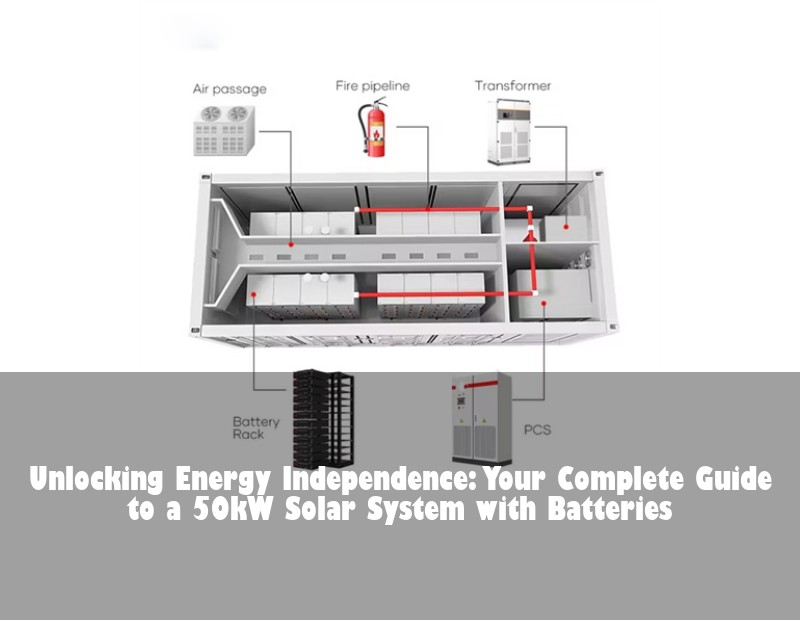
Table of Contents
- The European Energy Challenge: Rising Costs & Grid Uncertainty
- What Exactly is a 50kW Solar System with Batteries?
- The Financial Calculus: ROI, Savings & Incentives
- Proof in Practice: A German Dairy Farm Case Study
- Key Technical Considerations for Optimal Performance
- Is Your Business Ready for the Energy Transition?
The European Energy Challenge: Rising Costs & Grid Uncertainty
you're managing a mid-sized business in Southern Europe – maybe a bustling hotel, a thriving manufacturing unit, or an agricultural operation. Your monthly energy bill arrives, and that familiar knot tightens in your stomach. Wholesale electricity prices across the EU remain significantly higher than pre-crisis levels, and grid stability can't always be taken for granted, especially during peak demand or extreme weather events. This volatility isn't just a line item; it eats into your margins and complicates long-term planning. For many commercial and industrial (C&I) energy consumers like you, the quest for predictable, affordable, and resilient power has become paramount.
This is where the integrated solution of a 50kW solar system with batteries steps into the spotlight. It represents a sweet spot – powerful enough to make a substantial dent in the operational costs of medium-sized enterprises, yet manageable in terms of footprint and investment. Adding batteries transforms solar from a daylight-only solution into a 24/7 energy asset.

What Exactly is a 50kW Solar System with Batteries?
Let's break down this powerful energy solution:
- The Solar Array (50kW): This is the energy generator. Typically comprising around 125-140 high-efficiency solar panels (depending on individual panel wattage, e.g., 400W panels), it occupies roughly 250-350 m² of suitable rooftop or ground space. In optimal European conditions (like Spain or Italy), it can produce 55,000 - 70,000 kWh annually.
- The Battery Storage (Key Component): This is the game-changer. Modern lithium-ion battery banks (e.g., Lithium Iron Phosphate - LFP chemistry) store excess solar energy generated during the day. Typical sizing for a 50kW solar system ranges from 100kWh to 200kWh of usable capacity, allowing businesses to cover evening operations or grid outages. The inverter manages the flow between solar, batteries, and your facility.
- The Intelligent Brain: An advanced energy management system (EMS) constantly analyzes energy production, consumption patterns, battery charge levels, and even grid price signals. It makes split-second decisions to maximize self-consumption, optimize financial savings, and ensure backup readiness.
Core System Components
| Component | Function | Typical Specs for 50kW System |
|---|---|---|
| Solar Panels | Convert sunlight to DC electricity | 125-140 panels (e.g., 400W each), Monocrystalline PERC |
| Hybrid Inverter(s) | Convert DC to AC, manage battery charging/discharging | 2-3 units (e.g., 25kW each), high-voltage battery compatible |
| Battery Storage | Store excess solar energy | 100-200kWh usable capacity, LFP chemistry |
| Energy Management System (EMS) | Optimize energy flows, monitoring, control | Cloud-based platform with AI forecasting |
| Mounting & Balance of System | Secure installation, wiring, safety | Rooftop/ground mounts, DC/AC cabling, disconnects |
The Financial Calculus: ROI, Savings & Incentives
You're likely thinking, "Does this make financial sense for my business?" Let's look at the numbers:
- Reduced Grid Reliance: By maximizing self-consumption of solar power (especially using stored battery energy during high-tariff periods), businesses can slash grid electricity purchases by 70-85% or more. Imagine cutting your energy bill by thousands of Euros annually.
- Peak Shaving: Batteries discharge during peak demand times when grid electricity is most expensive, avoiding punitive demand charges common in commercial tariffs.
- ROI Timeline: While initial investment varies, payback periods in Europe often fall between 5-8 years, thanks to high energy prices and incentives. The system's lifespan (25+ years for solar, 10-15 years for batteries with proper cycling) means decades of reduced operating costs post-payback.
- European Incentives: Many European countries offer significant support:
- Germany: KfW loans with favourable terms for efficiency measures, potential for reduced VAT.
- Italy: Superbonus 110% (evolving, check current status) or regional incentives.
- Spain: Deductions for energy efficiency investments in corporate tax, regional grants.
- Netherlands: SDE++ subsidy for renewable energy production. Always consult a local expert for the latest programs!

Proof in Practice: A German Dairy Farm Case Study
Let's move beyond theory. Consider Hofgut Möggenried, a medium-sized organic dairy farm near Munich, Germany. Facing rising energy costs for milking equipment, cooling tanks (24/7 operation!), and general farm operations, they installed a 50kW solar system coupled with a 120kWh LFP battery in early 2022.
- The Challenge: High daytime energy use for milking, critical overnight cooling needs, vulnerability to grid fluctuations affecting sensitive equipment.
- The Solution: 132 x 380W panels, 2 x 25kW hybrid inverters, 120kWh modular battery storage, intelligent EMS prioritizing cooling load and milking schedules.
- The Results (12 Months Post-Installation):
- Grid Consumption Reduction: 81% decrease in grid electricity purchased.
- Self-Consumption Rate: Increased from ~35% (solar only) to over 92% (solar + batteries).
- Peak Demand Charges: Eliminated completely through strategic battery discharge.
- Backup Security: Successfully weathered several short grid outages without disrupting milk cooling.
- Estimated Annual Savings: €18,500 (factoring in avoided energy costs and peak charges).
- CO2 Reduction: ~42 tonnes annually. (Source: Project data provided by Solar Pro partner EnerTech GmbH, Bavaria. Names used with permission).
"The battery is crucial," noted the farm manager. "Knowing our cooling is secure overnight, regardless of the grid, and seeing those demand charges disappear – that's where the real value lies for us."
Key Technical Considerations for Optimal Performance
As a Solar Pro expert, I emphasize that success hinges on more than just bolting panels to a roof. Here’s what truly matters:
- Site-Specific Design: A thorough assessment of your roof structure (load-bearing capacity!), shading patterns, existing electrical infrastructure, and precise energy load profile (not just total kWh, but *when* you use it) is non-negotiable.
- Component Synergy: Choosing compatible components is vital. The hybrid inverter must seamlessly communicate with the chosen battery system. Panel voltage must match inverter input ranges. Cutting corners here risks inefficiency or system faults.
- Battery Chemistry & Warranty: LFP (Lithium Iron Phosphate) is the preferred choice for commercial storage due to its safety, long cycle life (6,000+ cycles to 80% depth of discharge is common), thermal stability, and lower degradation. Scrutinize the warranty – look for throughput guarantees (MWh) and end-of-warranty capacity retention.
- Intelligent Control (EMS): This is the brain. A sophisticated EMS uses algorithms and sometimes weather forecasts to:
- Prioritize self-consumption of solar.
- Charge batteries when solar is abundant/grid is cheap.
- Discharge batteries during expensive grid periods or outages.
- Provide detailed monitoring and reporting.
- Professional Installation & Commissioning: Compliance with local grid codes (like VDE-AR-N 4105 in Germany or CEI 0-21 in Italy), safety standards, and proper commissioning ensures safety, performance eligibility for incentives, and grid approval. Partner with certified installers like Solar Pro's network.
For deeper technical standards, refer to the International Electrotechnical Commission (IEC) standards relevant to solar and storage.

Is Your Business Ready for the Energy Transition?
Integrating a 50kW solar system with batteries isn't just an energy upgrade; it's a strategic business decision with tangible benefits: slashing operational costs, insulating yourself from volatile energy markets, enhancing your sustainability credentials (valued increasingly by customers and partners), and ensuring operational resilience against grid disruptions. The technology is mature, proven, and financially compelling across much of Europe today.
Solar Pro specializes in designing and delivering tailored commercial solar-plus-storage solutions. We navigate the complexities of site assessment, component selection, incentive applications, grid compliance, and professional installation – so you can focus on your core business, powered by clean, reliable, and cost-effective energy.
What specific energy challenge is keeping your operations manager up at night, and how could predictability in your energy costs transform your business planning?
 Inquiry
 Online Chat